
When You Need 24 Hour Care for Elderly Near Me: What Chicago Families Should Know First
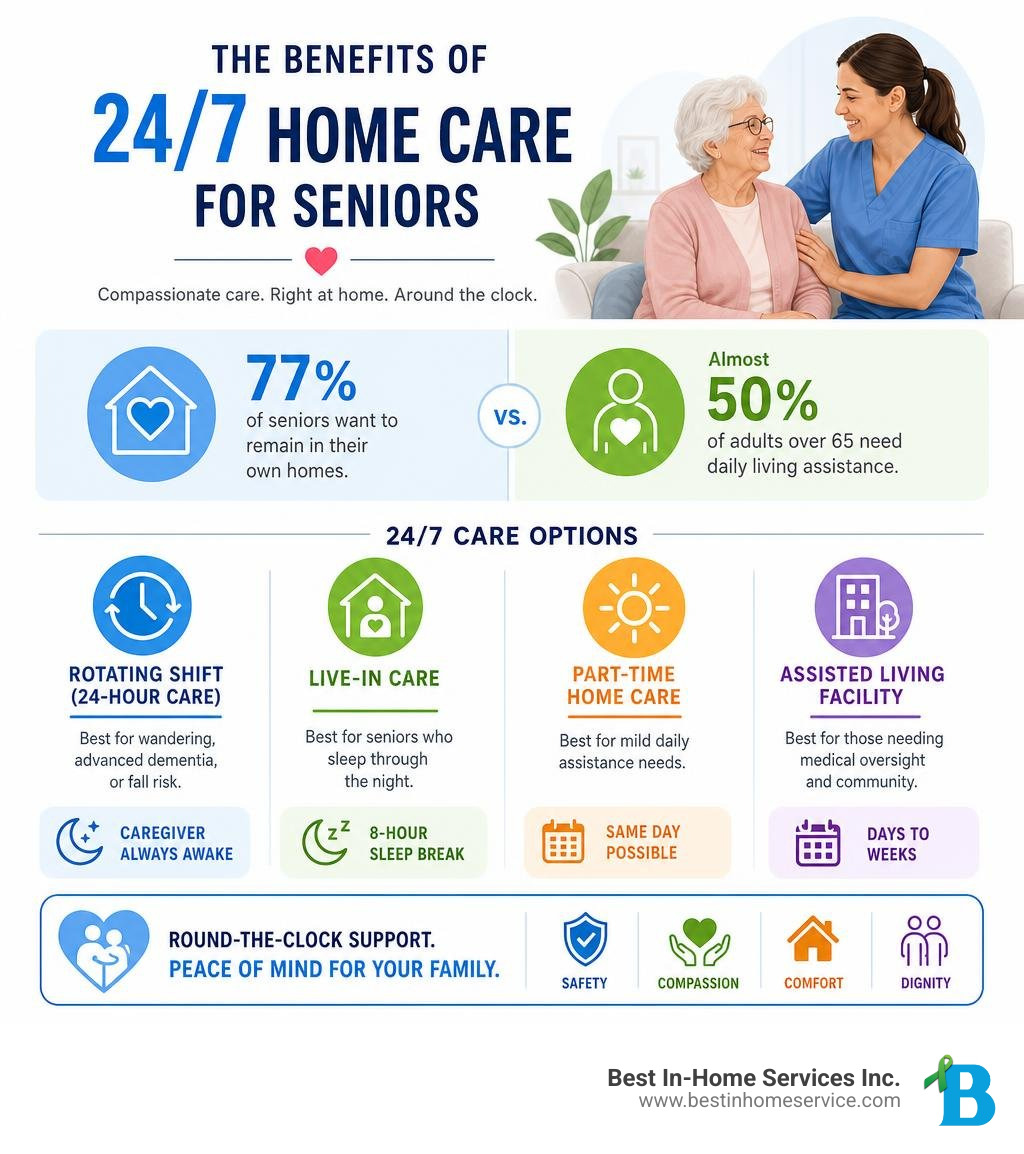
If you’re looking for 24 hour care for elderly near me in Chicago or the surrounding Cook County area, here is a quick overview of your main options:
| Care Type | Best For | Caregiver Always Awake? | Typical Start Time |
|---|---|---|---|
| Rotating shift (24-hour) | Wandering, advanced dementia, fall risk | Yes | 24-48 hours |
| Live-in care | Seniors who sleep through the night | No (8-hr sleep break) | 24-48 hours |
| Part-time home care | Mild daily assistance needs | No | Same day possible |
| Assisted living facility | Those needing medical oversight | Varies | Days to weeks |
Almost 50% of adults over 65 need daily living assistance — yet 77% of seniors want to remain in their own homes. That gap is exactly why round-the-clock in-home care has become one of the most important decisions families face.
The need can come on suddenly. A fall. A hospital discharge. A phone call where something just sounds different. And when that moment arrives, most families have no idea where to start.
This guide is here to change that.
I’m Lily Harrison, General Manager at Best In-Home Services Inc., where I’ve spent years helping Chicago-area families navigate 24 hour care for elderly near me — matching seniors with certified caregivers who provide compassionate, around-the-clock support at home. If you’re feeling overwhelmed right now, you’re in the right place.
24 hour care for elderly near me terms to learn:
Understanding 24-Hour Home Care vs. Live-In Care
When families begin searching for continuous support, they often use terms like “live-in care” and “24-hour care” interchangeably. However, in the professional caregiving world, these two models have distinct operational, financial, and practical differences. Making the right choice depends heavily on your loved one’s nighttime needs and daily patterns.

The core difference centers on whether the caregiver is permitted to sleep.
In a live-in care arrangement, a single caregiver resides in the home for several consecutive days. This model operates under strict labor guidelines: the caregiver must be provided with a private bedroom, a bed to rest, and a guaranteed, uninterrupted 8-hour sleep period each night. If your loved one sleeps peacefully through the night and only needs occasional, minor assistance (such as a single guided trip to the bathroom), live-in care can be an excellent, highly consistent option.
Conversely, true 24-hour home care uses rotating shifts—typically two 12-hour shifts or three 8-hour shifts within a 24-hour period. In this model, caregivers do not live in the home, do not require a bedroom, and are legally required to remain awake, alert, and fully active throughout their entire shift. This is the gold standard for seniors who experience frequent nighttime waking, wandering, high fall risks, or advanced stages of cognitive decline.

To help you visualize these differences, we have mapped out the key distinctions:
| Operational Feature | Live-In Care Model | Rotating Shift 24-Hour Care Model |
|---|---|---|
| Caregiver Sleep | Allowed and required (8 hours of designated rest) | Prohibited (caregivers remain fully awake and active) |
| Living Quarters | Requires a private bedroom and bed | No special accommodations or private room required |
| Staffing Structure | Usually 1 caregiver staying for 3–4 days, then swapping | 2 to 3 caregivers rotating on awake shifts daily |
| Best Suited For | Seniors who sleep through the night | Seniors with high fall risks, wandering, or sundowning |
| Consistency | Highly consistent; fewer faces in the home | Excellent coverage; multiple trained eyes on the senior |
For a deeper dive into how these schedules work in the Chicago area, you can read our comprehensive guide on Live-In Care Options in Chicago: Best In-Home Care.
When to Search for 24 Hour Care for Elderly Near Me
Recognizing the exact moment when part-time care is no longer sufficient can prevent a major household crisis or medical emergency. Some of the most common warning signs that your elderly loved one needs round-the-clock supervision include:
- Frequent Falls or Unsteadiness: According to the CDC, one in four older adults ages 65 and older falls every year. If you notice unexplained bruises, a sudden fear of walking, or if your loved one is using furniture to steady themselves, they need continuous physical support.
- Cognitive Decline and Wandering: If a senior is diagnosed with Alzheimer’s or another form of dementia, progressive confusion can lead to dangerous behaviors. Wandering out of the house, leaving the stove on, or experiencing severe “sundowning” (increased agitation and confusion in the late afternoon and evening) requires an awake caregiver to ensure safety. For specialized advice, refer to our 24/7 Dementia Home Care Guide.
- Incontinence Issues: Managing incontinence around the clock is physically demanding. Without prompt assistance, skin breakdown, urinary tract infections (UTIs), and slip-and-fall accidents on wet floors become major hazards.
- Recent Hospitalization or Surgery: Returning home after a major medical event often leaves seniors temporarily weak and unable to perform basic tasks safely.
The Staffing Models: Live-In Caregiver vs. Rotating Shifts
Understanding how these models are billed and staffed is crucial for long-term financial and logistical planning.
With live-in care, the caregiver is typically paid a flat daily rate. Because they receive a designated sleep break and downtime, this daily rate is often equivalent to roughly 13 to 15 hours of hourly pay. This makes it a highly cost-effective option if the senior’s care needs are concentrated during daytime hours. You can read more about how local families structure these arrangements in our resource on Live-In Care Options in Chicago: Best In-Home Care.
With rotating shift care, the agency bills on a strict hourly basis for all 24 hours of the day. Because the caregivers are working awake shifts, there are no sleep breaks. While this model is more expensive, it ensures that there is never a moment when your loved one is left unmonitored. If a senior wakes up confused at 3:00 AM, a fully awake caregiver is right there to redirect them gently, prevent a fall, and help them back to bed.
Finding the Best 24 Hour Care for Elderly Near Me: The Benefits of In-Home Care
When families realize that their loved one can no longer live safely alone, they often assume that moving to an assisted living facility or a nursing home is the only option. However, 24-hour in-home care offers distinct advantages that facility-based care simply cannot replicate.

The most significant advantage is the one-on-one care ratio. In even the finest assisted living facilities or nursing homes, a single nurse or aide is responsible for managing the needs of dozens of residents simultaneously. This means your loved one must wait their turn for assistance with toileting, transfer support, or basic comfort.
With a dedicated in-home caregiver, your loved one receives undivided, personalized attention. The caregiver learns their exact preferences—how they like their morning coffee, their favorite music, the precise way they prefer to be transferred from bed to chair, and their established daily routines. This level of personalized care is especially comforting for seniors living with memory loss, where changes in environment can trigger severe confusion and anxiety.
Staying at home also allows seniors to maintain their independence, keep their beloved pets, and remain surrounded by decades of cherished memories. To learn more about how to navigate these choices, explore our guide on Finding the Best 24/7 Home Health and Memory Care in Chicago.
Why Seniors in Chicago and Cook County Prefer Aging in Place
Throughout Chicago and the surrounding Cook County suburbs—from the quiet streets of Winnetka and Glenview to the bustling neighborhoods of Skokie and Des Plaines—seniors have a deep-rooted desire to age in place.
Staying in a familiar neighborhood means remaining close to long-time friends, local places of worship, and familiar community centers. It means being able to look out the window at a familiar yard or taking a supervised walk down a familiar street.
At Best In-Home Services Inc., we design personalized care plans that respect these local connections. Our caregivers do not just assist with physical needs; they help seniors continue living the lives they love in the communities they call home. Whether that means a supervised outing to a local park in Downers Grove or simply sitting on the porch in Naperville, we focus on preserving quality of life. For more on finding local caregivers who understand these neighborhoods, see our resource on Caregivers for Seniors Near Me: Finding Local Care in Chicago.
Services Included in 24-Hour Non-Medical Home Care
Non-medical 24-hour home care is designed to support seniors with both Activities of Daily Living (ADLs) and Instrumental Activities of Daily Living (IADLs). These services are comprehensive and customized to each individual’s needs:
- Personal Care and Hygiene: Dignified assistance with bathing, showering, hair care, oral hygiene, dressing, and toileting.
- Mobility and Transfer Support: Helping seniors safely transfer from bed to wheelchair, navigate stairs, and move around the home to prevent falls.
- Medication Reminders: Ensuring seniors take the correct dosages of their medications at the prescribed times.
- Meal Preparation and Hydration: Cooking nutritious meals tailored to dietary restrictions, managing grocery shopping, and encouraging proper fluid intake.
- Light Housekeeping: Keeping the living environment clean, safe, and organized by managing laundry, washing dishes, and removing tripping hazards.
- Companionship and Social Engagement: One out of every three older adults reports a lack of companionship and feeling alone. Our caregivers provide warm conversation, play games, read, and offer emotional support to combat isolation.
- Safety Supervision: Continuous monitoring to prevent wandering, accidents, or household hazards like leaving appliances running.
To see a complete list of how we can support your family, Explore Our Professional Home Care Services.
Costs, Payment Options, and Local Resources
Planning for the financial aspects of 24-hour care is one of the most important steps a family can take. Because around-the-clock care involves extensive hours, understanding the local cost landscape and the available payment structures is essential.
Average Costs of 24-Hour Care in Chicago and Illinois
In the Chicago metropolitan area, including Cook County, DuPage County, and Lake County, the cost of home care is determined by the level of service required and the staffing model chosen.
Hourly rates for home care in the Chicago area generally range from $30 to $45 per hour. If a family utilizes a rotating shift 24-hour awake care model (24 hours billed hourly), the daily cost can range from $720 to $1,080. Over a monthly period, this represents a significant financial commitment.
However, if the senior qualifies for a live-in care model, the daily flat rate is typically much lower than the cumulative hourly rate, making it a more accessible option for long-term planning. Families often find that when compared to the high cost of private rooms in premier assisted living or skilled nursing facilities in areas like Hinsdale, Oak Brook, or Glencoe, in-home care provides far superior value due to the dedicated, one-on-one attention.
To get a clearer picture of how to budget for these services, check out our detailed breakdown on Finding the Best 24/7 Home Health and Memory Care in Chicago.
Local Chicago Resources and Illinois Licensing
Navigating the legal and regulatory landscape in Illinois ensures that you are hiring a safe, reputable provider. In the state of Illinois, non-medical home care agencies (referred to legally as Home Services Agencies) must be licensed by the Illinois Department of Public Health (IDPH).
When evaluating providers, always verify that the agency is fully licensed, bonded, and insured. A licensed agency is legally required to perform rigorous background checks, verify caregiver training, and maintain professional liability and workers’ compensation insurance. This protects your family from liability in the event of an on-the-job injury.
There are also several public and community resources available to help families find support:
- Area Agency on Aging: Local offices can provide guidance on senior programs, respite care grants, and local support services.
- Veterans Benefits (Aid and Attendance): Veterans and their surviving spouses may qualify for a pension upgrade that helps cover the costs of in-home care.
- Long-Term Care Insurance: Many policies cover non-medical personal care once a senior requires assistance with a certain number of ADLs.
- Local Community Services: Programs like the Community Services Programs | DuPage Co, IL offer valuable resources and local support networks for residents in DuPage County.
For more information on navigating local regulations and state programs, read our guide on 24-Hour In-Home Care in Illinois: Essential Support for Recovery.
How to Arrange 24 Hour Care for Elderly Near Me After Hospital Discharge
Many families find themselves searching for 24 hour care for elderly near me during a sudden crisis, such as an unexpected hospital stay at a local facility like Northwestern Memorial or Evanston Hospital. When discharge day approaches, the hospital social worker or transitional care nurse may inform you that your loved one cannot safely return home alone.
This transition period is critical. A poorly managed transition from hospital to home is a leading cause of preventable readmissions.
Fortunately, reputable agencies can arrange 24-hour care rapidly—often within 24 to 48 hours of your initial call. The process typically begins with an immediate in-home or in-hospital assessment by a care manager to evaluate the senior’s physical needs, cognitive status, and home safety environment. A customized care plan is then built, and a compatible caregiver is matched to start immediately upon discharge.
To learn more about managing this transition smoothly, read our dedicated article on 24-Hour In-Home Care in Illinois: Essential Support for Recovery.
Screening, Training, and Matching Caregivers
At Best In-Home Services Inc., we understand that inviting caregivers into your home around the clock requires an immense amount of trust. That is why we employ a rigorous screening and matching process to ensure your peace of mind:
- Comprehensive Background Checks: Every caregiver undergoes criminal background checks, fingerprinting, and reference verifications.
- Skills and Training Verification: Our staff consists of certified, highly trained professionals who undergo continuous education in advanced care techniques, including specialized dementia and memory care.
- Personality and Routine Matching: We do not just assign the first available caregiver. We carefully match caregivers based on their skills, personality, and compatibility with your loved one’s daily routines and interests.
- Ongoing Supervision: Our care managers conduct regular check-ins and supervisory visits to ensure that the care plan is being followed precisely and updated as needs change.
For more details on our hiring and matching standards, check out Caregivers for Seniors Near Me: Finding Local Care in Chicago.
Frequently Asked Questions About 24-Hour Care
What is the difference between 24-hour care and overnight care?
Overnight care typically covers a specific block of nighttime hours (such as 8:00 PM to 8:00 AM) to assist with bedtime preparation, occasional nighttime bathroom trips, and morning routines. 24-hour care provides continuous, uninterrupted support throughout both day and night, ensuring that a caregiver is present and active 24 hours a day.
Will Medicare or Medicaid pay for 24-hour home care?
Generally, Medicare does not pay for long-term, non-medical 24-hour home care; its coverage is limited to short-term, medically necessary intermittent home health visits. Illinois Medicaid may cover some home care services through specific waiver programs (like the Community Care Program), but these programs rarely cover full 24-hour continuous care. Most families utilize private pay, long-term care insurance, or VA benefits to fund 24-hour care.
How quickly can 24-hour care be set up?
In urgent situations, such as a sudden hospital discharge or a rapid decline in health, care can often be initiated within 24 to 48 hours. The process begins with a rapid phone assessment followed by an in-home safety evaluation to ensure a safe, smooth start to services.
Conclusion
Finding the right 24 hour care for elderly near me is about more than just filling hours on a schedule—it is about restoring peace of mind to your entire family. With the right support, your aging loved one can remain in the comfortable, familiar surroundings of their own home while receiving the dedicated, compassionate, and professional care they deserve.
At Best In-Home Services Inc., we are committed to providing the highest standard of personalized, around-the-clock care to families across Chicago, Cook County, DuPage County, Lake County, and the surrounding suburbs. We design custom care plans that adapt to your family’s unique needs, ensuring safety, dignity, and comfort at every hour of the day and night.
If you are ready to take the next step or simply have questions about your options, we invite you to Explore Our Professional Home Care Services or contact us today to schedule your free, personalized care consultation.





 1-224-636-5200
 1-224-636-5210
  425 Huehl Rd 13B Northbrook IL 60062