
Finding the Right Live in Caregiver Chicago Families Can Afford
A live in caregiver Chicago families choose can provide daily help, companionship, personal care, and overnight peace of mind while a loved one remains at home. The right option depends on the senior’s care needs, whether care is needed around the clock, and how the family plans to pay.
| Quick answer | What to know |
|---|---|
| Typical caregiver pay | Chicago live-in caregivers average about $16 per hour, though reported rates range from $8.47 to $25.25 per hour. |
| Experience matters | Reported average total pay is about $11.75 per hour for caregivers with 1-4 years of experience and $15.01 per hour for those with 5-9 years. |
| Ways to arrange care | Families may work with a licensed agency, hire directly, or explore Illinois programs that may support eligible older adults or people with disabilities. |
| Important first checks | Confirm training, background-check status, and eligibility through the Illinois Department of Public Health Healthcare Worker Registry when considering an independent caregiver. |
Live-in care can be a practical choice for seniors living with dementia, memory changes, mobility limits, or a growing need for help with everyday routines. It can also be confusing: “live-in” care is not always the same as 24-hour shift coverage, and total costs can differ based on the schedule, level of care, and hiring arrangement.
I’m Lily Harrison, General Manager at Best In-Home Services Inc., where I help Chicago families coordinate personalized in-home support for seniors who need dementia care, daily assistance, or 24/7 care at home. In this guide, I’ll help you understand the real options behind Live in caregiver Chicago care so you can make a safer, more confident decision.
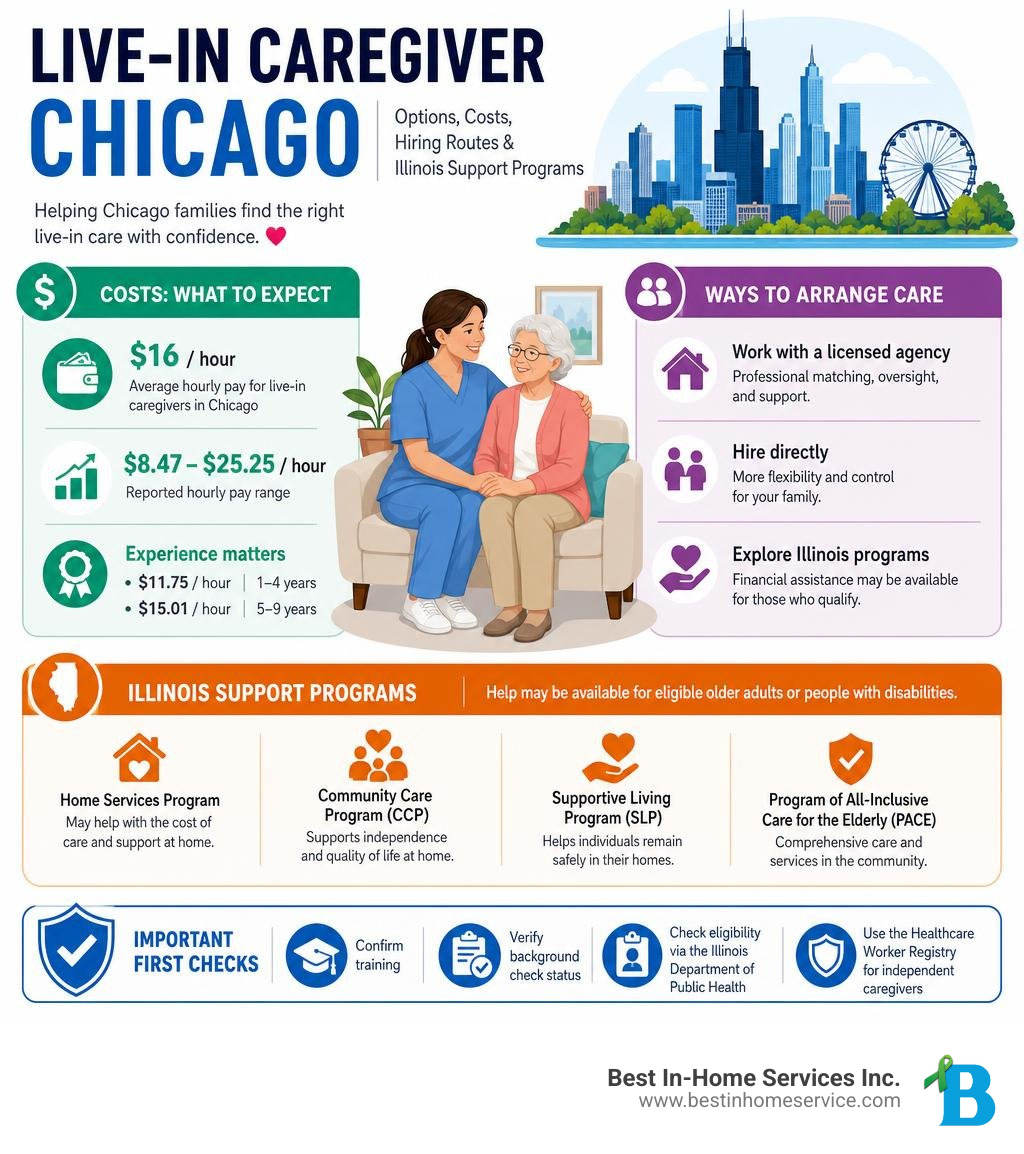
Simple guide to Live in caregiver in Chicago:
Understanding Live in Caregiver Chicago Pay Rates and Hiring Costs

When exploring options for a Live in caregiver Chicago families often ask two core questions: What does it actually cost? and How is care structured financially? Understanding market compensation benchmarks helps families set a realistic budget while ensuring fair pay for quality care.
At Best In-Home Services Inc., we work closely with families across Cook County, DuPage County, Lake County, and surrounding Chicagoland communities to ensure full transparency regarding care investments. Whether you are navigating private-pay home care or evaluating financial assistance pathways, understanding wage structures in 2026 is an essential starting point. For an in-depth breakdown of private care finances, explore our guide on 24-Hour Care for Elderly Chicago Cost: Will It Break the Bank?.
Average Hourly Pay for a Live in Caregiver Chicago
Data from compensation surveys such as Live-In Caregiver Hourly Pay in Chicago, Illinois in 2026 | PayScale provides clear benchmarks for base caregiver pay in the Chicago metropolitan area:
- Average Base Hourly Rate: The average base pay for a Live in caregiver Chicago professional sits at $16.00 per hour.
- Pay Percentile Range: Hourly compensation ranges from a 10th percentile rate of $8.47 per hour up to $25.25 per hour at the 90th percentile, depending on skill specialization, care complexity, and employer type.
- Experience Tiers: Caregiver wages scale directly with hands-on experience:
- Early-Career (1–4 years): Averages $11.75 per hour total compensation.
- Mid-Career (5–9 years): Averages $15.01 per hour total compensation.
- Annual Earning Expectations: Total annual pay across the Chicago market spans between $18,000 and $52,000, with occasional performance bonuses ranging up to $491.
- Demographics & Benefits: Recent survey data indicates that 100% of responding live-in caregivers in Chicago identify as female, and 100% report receiving zero employer-sponsored health benefits when working independently.
When evaluating these hourly figures, families must distinguish between basic home care aides and specialized caregivers trained in memory care, mobility transfers, or advanced personal hygiene.
Agency vs. Direct Hiring Cost Structure
Choosing between hiring an independent caregiver directly versus partnering with a licensed home care agency impacts overall expense, employer liability, and peace of mind.
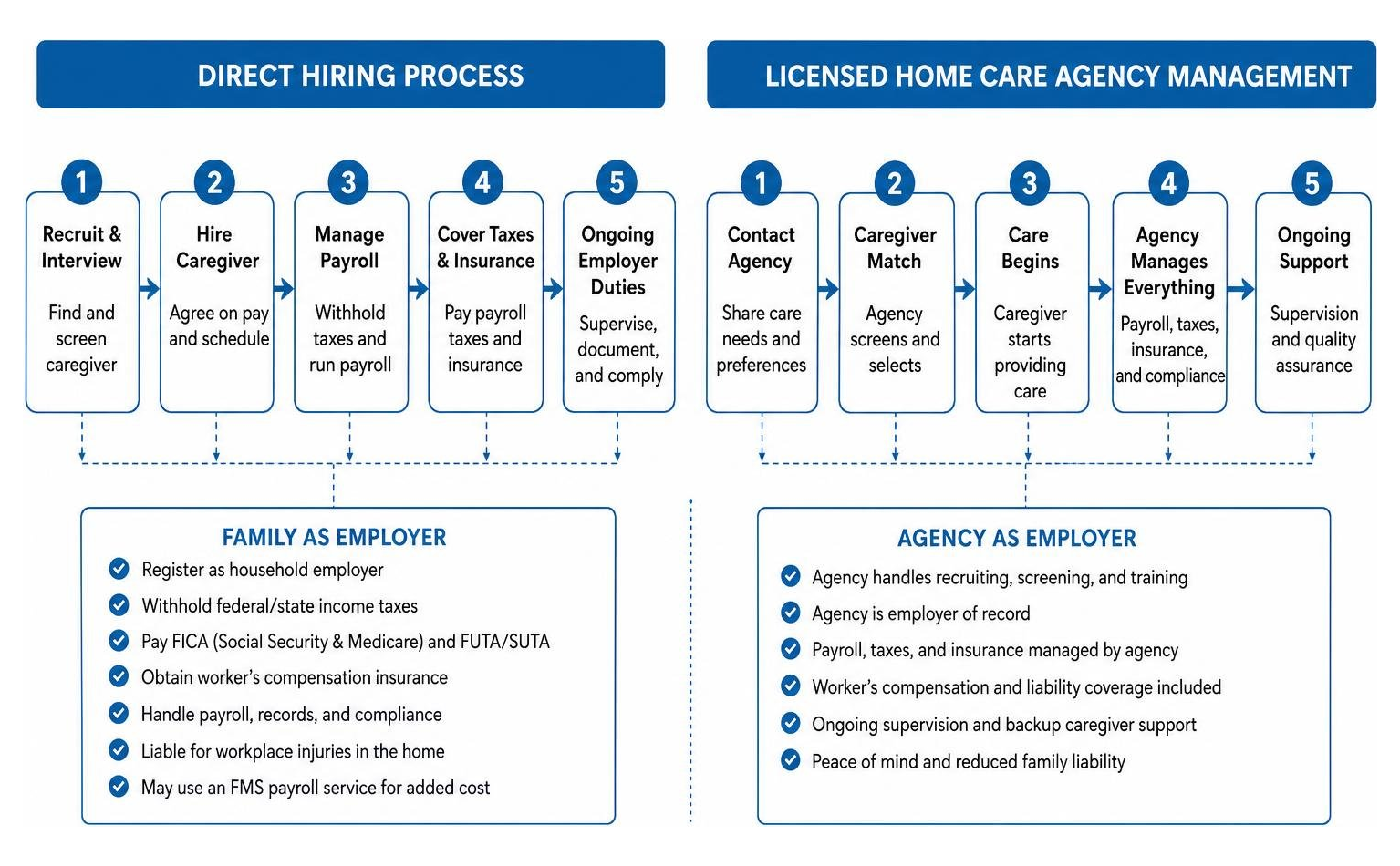
1. Hiring Directly as an Employer
When families hire an independent caregiver, the baseline hourly wage may seem lower initially, but extra responsibilities and costs quickly accumulate:
- Tax Withholding & Payroll: Families must register as household employers, withhold federal/state income taxes, and pay FICA (Social Security and Medicare) as well as federal and state unemployment taxes (FUTA/SUTA).
- Worker’s Compensation & Liability: Direct employers are liable for workplace injuries happening inside the home, requiring household worker’s compensation insurance policies.
- Financial Management Systems (FMS): Many private employers hire an FMS payroll intermediary to process paychecks legally, adding monthly administrative fees.
- Back-Up Coverage: If a direct caregiver falls ill or takes personal time off, the family must personally step in or scramble to find temporary respite care.
2. Partnering with a Licensed Home Care Agency
Working with an established, licensed agency like Best In-Home Services Inc. streamlines the entire experience into a predictable, all-inclusive rate:
- Zero Household Employer Liability: We handle all legal employment taxes, payroll withholding, worker’s compensation, and professional liability insurance.
- Screened & Certified Staff: Every caregiver undergoes rigorous background checks, reference verifications, and ongoing clinical oversight.
- Guaranteed Coverage & Backup: If your primary caregiver is unavailable, we provide seamless, qualified replacement coverage so your loved one is never left unattended.
State and Municipal Support Programs in Illinois
For many families, private-pay care is combined with or transitioned into public assistance programs funded by the State of Illinois and municipal agencies. Public programs can offer vital support for seniors aging in place. Learn more about why remaining at home is ideal in our article on Why Senior Care at Home Is the Best Choice for Aging in Place, as well as our overview on In-Home Senior Support: Helping Loved Ones Age Gracefully.
Community Care Program (CCP) and Home Services Program Eligibility
Illinois operates two primary Medicaid-funded or state-subsidized programs designed to help individuals avoid premature nursing home placement:
| Program Feature | Community Care Program (CCP) | Home Services Program (HSP) |
|---|---|---|
| Administering Agency | Illinois Department on Aging (IDoA) | Division of Rehabilitation Services (DRS / IDHS) |
| Age Eligibility | Adults aged 60 years or older | Individuals under age 60 |
| Primary Requirement | Needs help with Activities of Daily Living (ADLs) and meets asset limits | Has a severe physical disability expected to last 12+ months |
| Out-of-Pocket Cost | $0 for fully eligible state participants | $0 for fully eligible state participants |
| Core Services Covered | In-home care assistance, adult day services, emergency response | Personal assistant services, home modifications, respite care |
To apply for CCP, seniors work with a regional Care Coordination Unit (CCU) that assesses functional needs using a Determination of Need (DON) score. Qualified applicants receive non-medical personal care, light housekeeping, and meal preparation at no out-of-pocket cost.
Chicago DFSS Caregiver Support and Respite Options
For residents within the City of Chicago, the Department of Family and Support Services (DFSS) Senior Services Division provides municipal support frameworks:
- TCARE Caregiver Screener: Caregivers can complete this standardized online assessment tool to evaluate stress levels, care challenges, and specific gaps in care.
- DFSS Delegate Agencies: Based on TCARE results, families are connected with localized community agencies offering care management, gap-filling grants, and educational workshops.
- Caregiver Respite Program: Temporary, short-term relief is provided by trained personal care staff either inside the senior’s home or in an approved supportive care facility. This gives primary family caregivers essential breaks for medical appointments, rest, or vacations.
- Target Audience: Chicago DFSS caregiver programs assist family members caring for adults aged 60+ or individuals of any age living with Alzheimer’s disease or related dementia disorders.
How to Hire a Family Member or Specialized Live in Caregiver Chicago
Navigating senior care involves matching specific medical or personal requirements with the appropriate provider pathway. Specialized memory care requires unique skills, which we cover extensively in our Live-in Care for Dementia: A Complete Guide for Families and our comprehensive 24/7 Dementia Home Care Guide.
When evaluating options across the region, exploring Live-in Care Options in Chicago: Best In-Home Care helps families clarify whether shift care or live-in arrangements best fit their situation.
Training, Background Checks, and IDPH Registry Requirements
Safety and clinical competence are non-negotiable when bringing a caregiver into a senior’s residence. The State of Illinois enforces strict statutory compliance:
- IDPH Healthcare Worker Registry Check: Before hiring any independent caregiver, families must search the Illinois Department of Public Health (IDPH) Healthcare Worker Registry. This public database verifies whether an individual has disqualifying criminal convictions, administrative findings of neglect, or verified elder abuse reports.
- Pre-Service Training Requirements: State regulations mandate that caregivers working through licensed agencies or state programs undergo structured foundational training. For example, paid caregivers under the IDoA Community Care Program must complete at least 24 hours of pre-service training covering safety protocols, mobility transfers, hygiene techniques, and elder abuse prevention.
- Ongoing Supervision & Care Plans: Licensed agencies mandate continuous oversight by a registered nurse or qualified care supervisor to ensure care aligns with a personalized Plan of Care.
Hiring Family Members or Friends as Paid Caregivers
Many Chicago families are surprised to learn that family members—including adult children, relatives, and in many cases spouses—can be legally employed and paid to provide care.
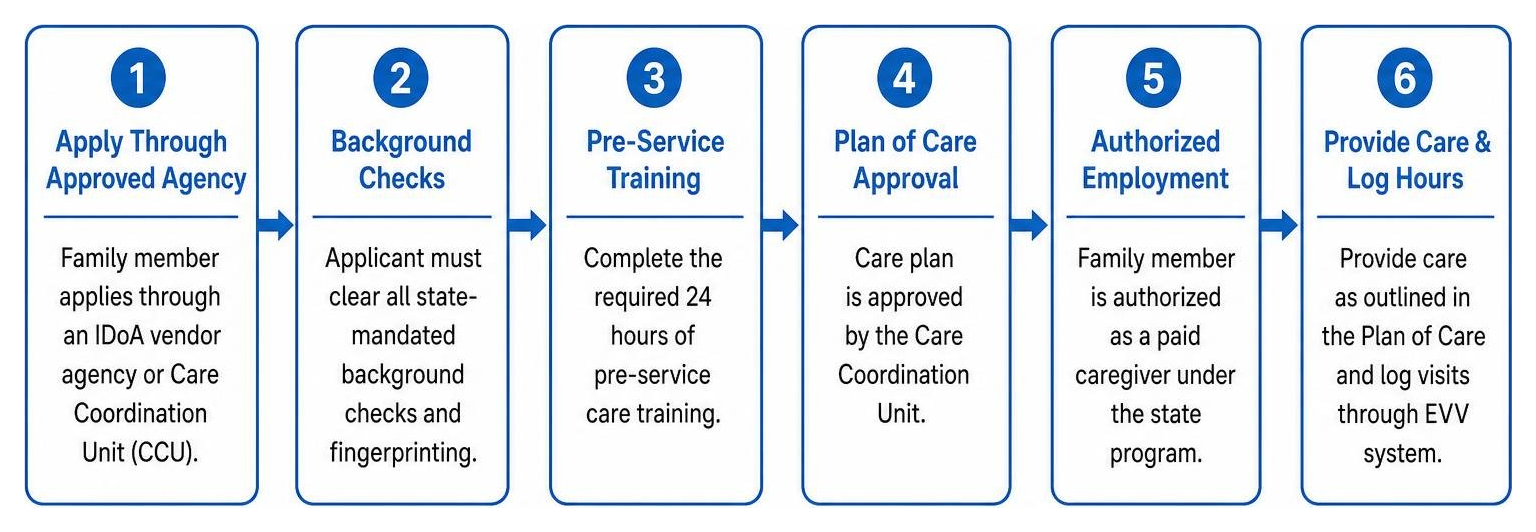
To convert a family caregiving relationship into paid employment under state-funded programs like CCP:
- The family member must apply through an approved IDoA vendor agency or Care Coordination Unit.
- The applicant must clear all state-mandated background checks and fingerprinting.
- The candidate must complete the required 24 hours of pre-service care training.
- Care hours and tasks must strictly follow the state-approved Plan of Care and be logged through Electronic Visit Verification (EVV) systems.
Regulatory Oversight and Licensing Compliance in Illinois
In Illinois, in-home care provider organizations are regulated to protect consumer safety and maintain standard levels of service.
The Illinois Department of Public Health (IDPH) oversees and licenses four distinct categories of home care entities:
- Home Services Agencies: Licensed to provide non-medical personal assistance, companionship, homemaking, and custodial care (the licensing category under which standard live-in non-medical care operates).
- Home Nursing Agencies: Licensed to provide skilled nursing services on a periodic or shift basis.
- Home Health Agencies: Licensed to deliver medical care, physical therapy, and skilled nursing under direct physician orders.
- Hospice Agencies: Specialized end-of-life care entities providing medical, emotional, and spiritual support.
| Comparison Aspect | Direct Hire / Independent Caregiver | Licensed Agency Care (e.g., Best In-Home Services Inc.) |
|---|---|---|
| IDPH License Oversight | None (Individual worker) | Full IDPH Home Services Agency Licensing |
| Registry Verification | Family must manually search IDPH Registry | Agency automatically conducts background checks |
| Mandatory Pre-Service Training | Unregulated (depends on worker) | Minimum 24 hours + specialized dementia training |
| Tax & Insurance Liability | Shifts entirely to family (Household Employer) | Fully covered by agency (FICA, FUTA, Workers’ Comp) |
| Plan of Care Supervision | Family manages directly | Supervised by designated care management staff |
| Emergency Backup | No guaranteed replacement | 24/7 staff replacement and backup coverage |
To ensure complete safety when choosing an agency, read our guide on How to Choose the Best 24-Hour Home Care Services for Peace of Mind and review our article on 24-Hour In-Home Care in Illinois: Essential Support for Recovery.
Frequently Asked Questions About In-Home Care in Chicago
What services are covered under in-home palliative care vs hospice care?
While both palliative care and hospice care focus on comfort and quality of life, they serve different clinical stages:
- In-Home Palliative Care: Designed for individuals living with serious, chronic illnesses (such as congestive heart failure, Parkinson’s, or advanced dementia) at any stage of the disease. Patients can receive palliative pain and symptom management alongside curative medical treatments. Services include interdisciplinary symptom management, emotional counseling, and care coordination.
- In-Home Hospice Care: Tailored specifically for individuals facing a terminal diagnosis with an estimated life expectancy of six months or less, where curative treatments have ceased. Hospice brings an interdisciplinary team—nurses, social workers, spiritual counselors, and hospice aides—into the home to handle end-of-life medical management, medical equipment provision, and family bereavement support.
Non-medical personal care providers often work alongside palliative or hospice medical teams to handle everyday bath assistance, meal prep, and overnight supervision.
How do I file a complaint about in-home care services in Illinois?
If you suspect sub-standard care, administrative misconduct, neglect, or abuse, several official regulatory bodies handle consumer reports in Illinois:
- IDPH Home Health & Health Care Facility Hotline: To report complaints regarding a licensed Home Services Agency, Home Health Agency, or hospice provider, call the IDPH central complaint toll-free hotline at 1-800-252-4343.
- Adult Protective Services (APS) Hotline: To report suspected physical abuse, emotional neglect, or financial exploitation of an older adult (60+) or an adult with a disability (18–59), call the state APS hotline immediately at 1-866-800-1409 (available 24/7).
- Illinois Long-Term Care Ombudsman Program: Ombudspersons act as advocates for consumers receiving home care or supportive living services, resolving care disputes and advocating for client rights.
Where can I find emergency response systems and respite care in Chicago?
- Electronic Home Response Systems (EHRS): Seniors can access 24/7 emergency signaling devices (wearable medical alert buttons or voice-activated systems). State programs like the Community Care Program often cover rental fees for eligible clients.
- Chicago DFSS Respite Programs: Chicago residents can contact the Senior HelpLine at 1-800-252-8966 or reach out to local DFSS regional senior centers to request subsidized respite care services.
- Private Respite Coverage: Agencies like Best In-Home Services Inc. offer flexible, short-term relief care ranging from a few days to several weeks, ensuring family caregivers can recharge safely. You can read more about shift arrangements in our resource on Finding the Best 24/7 Home Health and Memory Care in Chicago and explore our review of 24/7 Certified Senior Care in Chicago IL.
Conclusion
Finding a trustworthy, affordable Live in caregiver Chicago families can rely on comes down to clear information, safety protocols, and proper care planning. Whether you are budgeting for private care, enrolling in state support programs like the Community Care Program, or hiring a family member as a paid caregiver, protecting your loved one’s dignity and well-being remains the ultimate objective.
At Best In-Home Services Inc., we provide customized 24/7 senior support, memory care, and certified caregiving across Chicago, Winnetka, Downers Grove, Evanston, Skokie, Naperville, and surrounding communities in Cook, DuPage, and Lake Counties. Our compassionate team is ready to help you navigate every step of the process with complete peace of mind.
To discuss your family’s needs or schedule a free care consultation, Explore Best In-Home Care Services today.





 1-224-636-5200
 1-224-636-5210
  425 Huehl Rd 13B Northbrook IL 60062