
What Does 24 Hour Care for the Elderly Actually Cost?
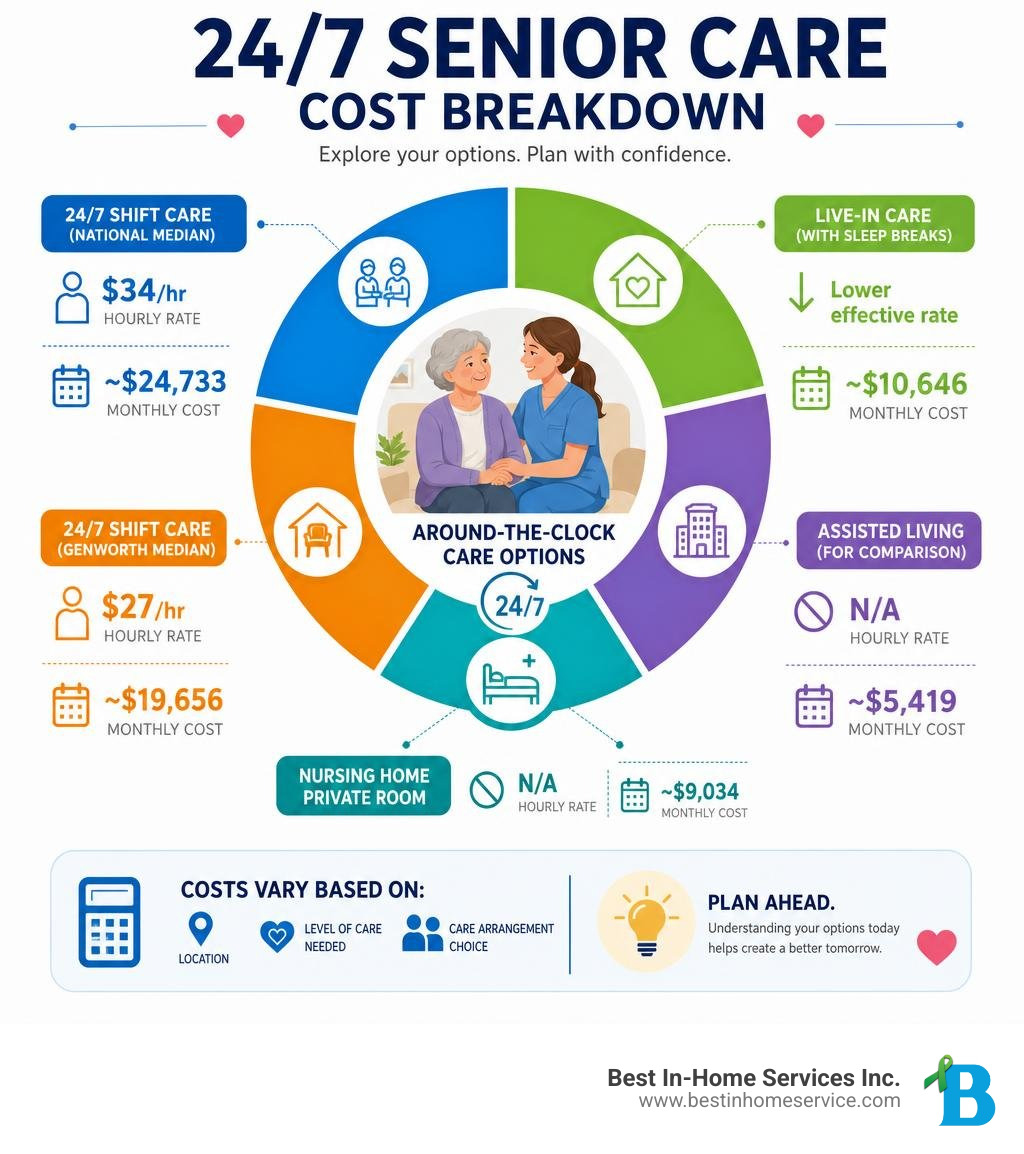
The cost of 24-hour care varies significantly depending on the provider, location, staffing arrangement, and level of support required. National market estimates for continuous in-home care can range from approximately $19,656 to $24,733 per month, while live-in arrangements and facility-based care follow different pricing structures.
Here’s a general market comparison to help families understand the different options:
| Care Arrangement | Hourly Rate | Monthly Cost |
|---|---|---|
| 24/7 shift care (national market estimate) | $34/hr | ~$24,733 |
| 24/7 shift care (Genworth median) | $27/hr | ~$19,656 |
| Live-in care (with sleep breaks) | Lower effective rate | ~$10,646 |
| Assisted living (for comparison) | N/A | ~$5,419 |
| Nursing home private room | N/A | ~$9,034 |
| Best In-Home Service 24-Hour Care | Customized rate | Customized quote |
The figures above are general market estimates for different care arrangements and do not represent Best In-Home Service pricing. At Best In-Home Service, Inc., our standard non-medical home care rates are $35 per hour for companion and homemaker care, $37 per hour for personal care assistance and respite care, $42 per hour for dementia or Alzheimer’s care, and $40 per hour for overnight care. A 3-hour minimum applies per visit. Because continuous 24-hour care can involve different schedules and levels of support, we provide a customized rate based on the client’s individual care needs.
Round-the-clock home care is one of the most significant financial commitments a family can make. Many families are caught off guard by the monthly totals — and by how much the final cost can change depending on the care arrangement. Whether you’re planning ahead or responding to a sudden health change, understanding how 24-hour care is structured is an important first step.
I’m Lily Harrison, General Manager at Best In-Home Service, Inc., where I help Chicago-area families understand 24 hour care for elderly cost, compare care arrangements, and build plans around the level of assistance their loved one actually needs. In this guide, I’ll walk you through the major cost factors, differences between 24-hour shift care and live-in arrangements, and options families can explore when planning for long-term support.
Glossary for 24 hour care for elderly cost:
Understanding the 24 Hour Care for Elderly Cost in 2026
When a doctor or hospital discharge planner in Cook County tells you that your mom or dad needs round-the-clock supervision, one of the first practical questions is usually: What will this level of care cost?
To understand the 24 hour care for elderly cost, it helps to first understand how continuous care is structured. Unlike part-time home care that may cover several hours of bathing assistance, meal preparation, companionship, or errands, true 24-hour care requires coverage throughout the day and night.
That does not mean every family will have the same schedule or the same bill. The final cost depends on the level of supervision required, whether awake overnight coverage is necessary, the type of assistance being provided, and how caregivers are scheduled.
If your loved one is recovering from a major medical event, such as a stroke or hip replacement, they may require temporary high-intensity support rather than permanent round-the-clock care. In these situations, it can be helpful to review 24-hour in-home care in Illinois and discuss whether continuous care is needed throughout recovery or whether the schedule can later be reduced.

Average Monthly and Hourly 24 Hour Care for Elderly Cost
National market data provides a useful reference point for understanding why continuous care can become expensive. Some industry estimates place non-medical home care around $27 to $34 per hour.
When those market rates are extended across all 24 hours of the day, the totals increase quickly. For illustration:
| Care Duration | Low-End Estimate ($24/hr) | Mid-Range Estimate ($27/hr) | High-End Estimate ($34/hr) |
|---|---|---|---|
| Daily Cost (24 Hours) | $576 | $648 | $816 |
| Weekly Cost (168 Hours) | $4,032 | $4,536 | $5,712 |
| Monthly Cost (Average) | $17,280 | $19,656 | $24,733 |
| Annual Cost | $207,360 | $235,872 | $296,796 |
These calculations are general market examples only. They are not Best In-Home Service rates and should not be used as a quote for care from our agency.
At Best In-Home Service, Inc., 24-hour care is provided at a customized rate because the staffing arrangement, schedule, and level of support can differ substantially from one client to another. Families receive an individualized quote before services begin.
If your loved one does not require full 24-hour coverage but needs someone available overnight, our Overnight Care rate is $40 per hour. A 3-hour minimum applies per visit.
How State Location Affects the 24 Hour Care for Elderly Cost
Geographic location is one of the most powerful cost drivers in the senior care industry. Across the United States, there is a massive spread between the most and least expensive states. For instance, Minnesota represents the high end of the spectrum, with median monthly costs for 24/7 care soaring to around $26,390. On the flip side, states like Louisiana and West Virginia offer some of the lowest rates, with monthly medians starting closer to $13,650.
Here in Illinois – specifically within Chicago and suburbs like Downers Grove, Winnetka, Schaumburg, and Naperville – rates tend to align closely with or slightly exceed the national average. According to local market data, the average cost of home care in Illinois hovers around $35 per hour.
That figure is a market reference, not the rate charged by every Chicago-area agency.
At Best In-Home Service, Inc., pricing depends on the actual service provided. Companion and homemaker care is $35 per hour, personal care assistance and respite care are $37 per hour, dementia or Alzheimer’s care is $42 per hour, and overnight care is $40 per hour. Continuous 24-hour care is quoted individually.
You can review broader historical trends and regional variations through Illinois home care cost data.
Shift Care vs. Live-In Care: How the Arrangements Compare
One of the most common points of confusion for families is the difference between “24-hour care” and “live-in care.” The terms are sometimes used interchangeably, but they describe different staffing arrangements and can therefore have very different costs.
Choosing the right arrangement depends on your loved one’s physical safety needs, cognitive health, mobility, and sleep patterns. For example, if you are caring for a senior with progressive cognitive decline, our 24-7 dementia home care guide can help you understand when active overnight supervision may be appropriate.

24-Hour Shift Care (Continuous Awake Coverage)
True 24-hour shift care generally uses multiple caregivers working scheduled shifts so that someone remains available and awake throughout the day and night.
- The Model: Caregivers rotate through scheduled shifts to provide continuous coverage without relying on one caregiver to remain on duty around the clock.
- Best For: Seniors who wander, have a high fall risk, require frequent nighttime transfers, experience severe sundowning, or need ongoing supervision because of advanced dementia or other safety concerns.
- The Cost: National market calculations can place continuous shift care around $19,000 to $24,000+ per month, depending on the assumed hourly rate. These figures are market estimates, not Best In-Home Service pricing. At Best In-Home Service, Inc., 24-hour care is provided at a customized rate based on the client’s schedule and care requirements.
Live-In Care (With Sleep Breaks)
Live-in care is structured differently from continuous awake 24-hour shift care. In a traditional live-in arrangement, the caregiver has designated rest and sleep periods rather than actively working every hour of the night.
- The Model: The caregiver stays in the home but has designated off-duty and sleeping periods that must comply with applicable care and employment requirements.
- Best For: Seniors who generally sleep through the night and need daytime assistance with meals, personal routines, light housekeeping, medication reminders, mobility, companionship, or other non-medical support.
- The Cost: General industry estimates often show live-in arrangements costing less than continuous 24-hour shift care because the staffing model is different. Some market estimates place live-in care around $10,646 per month, but this figure is not a Best In-Home Service rate. Families considering extended or continuous support through Best In-Home Service receive a customized quote based on the actual care arrangement required.
The Financial Value of 24-Hour In-Home Care vs. Facility Placement
When families first see the potential cost of continuous home care, assisted living or nursing home placement may appear to be the less expensive alternative. But comparing monthly figures alone does not tell the whole story.
Home care and residential facilities provide fundamentally different living arrangements, staffing models, levels of individual attention, and flexibility.
For a deeper look at these differences, read our detailed comparison of home care vs assisted living.
Why Personalized 1-on-1 In-Home Care Outperforms Institutional Living
For comparison, national market estimates place assisted living at approximately $5,419 per month and a private nursing home room at approximately $9,034 per month. These are general facility-cost estimates and are not Best In-Home Service rates.
Comparing these figures with in-home care requires looking beyond the base monthly price.
- One-on-One Attention: In a residential facility, staff members usually assist multiple residents. With dedicated in-home care, the caregiver’s attention is focused on one client and that client’s daily routine, safety, comfort, and immediate needs.
- Additional Facility Fees: Assisted living pricing may include a base housing charge, while additional help with bathing, dressing, medication routines, mobility, transfers, or incontinence can result in higher care-level fees. Families should compare the complete expected cost rather than only the advertised base rate.
- The Comfort of Familiar Surroundings: Remaining at home allows an older adult to keep familiar routines, possessions, pets, neighborhood connections, and a living environment they already know. This can be especially meaningful for someone living with dementia or memory loss.
With customized in-home care, families are not simply purchasing a block of time. They are choosing a care arrangement built around the individual’s schedule, daily routines, safety concerns, and level of assistance.
Financial Assistance and Ways to Manage the Expenses
Continuous home care can represent a significant financial commitment, particularly when support is needed throughout the day and night. Because Best In-Home Service provides customized pricing for 24-hour care, families can first discuss the required schedule and level of support and then receive a quote based on their specific situation.
If you live in DuPage County, including Naperville, Woodridge, or Oak Brook, it may also be worth reviewing available programs through DuPage County Community Services.
Government Programs and Insurance Options
Understanding which programs may help pay for care can be complicated. The options available depend on eligibility, the type of care required, insurance coverage, and the individual’s financial circumstances.
- Medicare Limitations: Medicare generally does not pay for ongoing 24-hour custodial care. It may cover qualifying short-term skilled home health services, such as intermittent skilled nursing or rehabilitation, when Medicare requirements are met. Long-term assistance with bathing, dressing, meals, companionship, and supervision typically requires another funding source.
- Medicaid Waivers: Medicaid Home and Community-Based Services programs may help eligible seniors receive care at home rather than in an institution. Eligibility and covered services depend on the applicable Illinois program and individual circumstances.
- Veterans Benefits: Eligible veterans and surviving spouses may be able to use VA benefits toward qualifying care expenses. Families should confirm current eligibility and benefit amounts directly with the Department of Veterans Affairs.
- Long-Term Care Insurance: Some long-term care insurance policies cover qualifying in-home care. Review the policy carefully for elimination periods, daily or monthly benefit limits, approved providers, and documentation requirements.
- Home Equity and Family Cost-Sharing: Some families use home equity or divide care expenses among adult children or other relatives. Financial decisions involving a home, investments, or long-term assets should be considered carefully with an appropriate financial professional.
Why Professional Agency Care Protects Your Family Better Than Private Hiring
When comparing 24 hour care for elderly cost, families may consider hiring an independent caregiver because the advertised hourly rate can appear lower.
However, hourly price is only one part of the financial picture. Hiring privately may place additional responsibilities on the family that a professional agency handles internally.
Here are several factors to consider:
- Employment and Tax Responsibilities: Depending on the working arrangement, a family hiring a caregiver directly may become responsible for payroll, tax reporting, and other employer obligations. Working with a professional agency can remove much of this administrative burden.
- Liability and Workers’ Compensation: Professional agencies maintain appropriate insurance and employment protections for their caregivers, reducing the amount of risk families have to manage directly.
- Backup Coverage: Caregivers get sick, take vacations, and experience emergencies. An agency can coordinate replacement coverage when the regularly scheduled caregiver is unavailable.
- Screening and Training: Agencies can manage caregiver background checks, references, onboarding, and training rather than leaving the family to handle the entire screening process independently.
For practical advice on navigating this decision without losing your mind, take a look at our guide on how to pick the best in-home care providers.
For practical advice on navigating this decision without losing your mind, take a look at our guide on how to pick the best in-home care providers.
Practical Tips to Reduce Round-the-Clock Care Costs
A full 24-hour schedule is not always necessary for every senior. The most cost-effective care plan is one that matches the hours of professional assistance to the person’s actual safety and daily-living needs.
- Consider Whether Overnight Awake Care Is Necessary: Some seniors require active nighttime supervision, while others mainly need support during waking hours. A professional assessment can help determine the appropriate schedule.
- Use the Right Level of Care for Each Need: Non-medical caregivers can assist with companionship, personal care, meal preparation, mobility, errands, and other everyday needs. Clinical services that require a licensed medical professional should be coordinated separately when necessary.
- Use Community Resources: Adult day programs and other community-based senior services may supplement home care and provide additional social engagement or respite for family caregivers.
- Improve Safety at Home: Grab bars, improved lighting, appropriate mobility equipment, ramps, and other home modifications can help reduce avoidable risks and make daily routines easier to manage.
For more ideas on balancing care needs and budget, explore our guide to affordable home care for seniors in Chicago.
Frequently Asked Questions About 24-Hour Care Costs
Does Medicare pay for 24-hour in-home care?
No, Medicare does not pay for 24-hour in-home custodial care. It only covers limited, short-term skilled medical care (such as physical therapy, occupational therapy, or intermittent skilled nursing) provided by a certified Medicare home health agency. If your loved one only requires personal assistance with daily tasks like bathing, dressing, meal preparation, and supervision, these services must be funded through other means, such as private pay, long-term care insurance, VA benefits, or Medicaid.
Because staffing requirements are different, the costs of the two arrangements can also differ considerably. At Best In-Home Service, Inc., 24-hour care is quoted at a customized rate based on the client’s required schedule and level of care.
What is the difference between 24-hour care and live-in care?
Best In-Home Service, Inc. provides a customized rate for 24-hour care rather than applying one standard hourly or monthly price to every client. The final rate depends on the required schedule, level of care, and individual needs of the person receiving support. A customized quote is provided before services begin.
For other non-medical services, our current rates include $35 per hour for companion and homemaker care, $37 per hour for personal care assistance and respite care, $42 per hour for dementia or Alzheimer’s care, and $40 per hour for overnight care. A 3-hour minimum applies per visit.
How can families afford 24/7 home care?
Families typically fund 24/7 care by combining multiple resources. This can include utilizing long-term care insurance policies, applying for VA Aid and Attendance pensions for wartime veterans, using Medicaid waivers for low-income seniors, tapping into home equity through a reverse mortgage, or setting up family cost-sharing agreements where siblings split the expenses. In many cases, families also choose to liquidate assets, such as selling the senior’s home, to fund their ongoing care needs.
Conclusion
Understanding 24 hour care for elderly cost begins with recognizing that there is no single price that applies to every family. National market estimates can provide useful context, but the actual cost depends on the care arrangement, schedule, level of supervision, and individual needs of the senior.
At Best In-Home Service, Inc., we do not apply a generic national monthly estimate to every 24-hour care plan. 24-hour care is quoted individually, allowing the rate to reflect the level and schedule of support the client actually requires.
Our non-medical caregivers serve seniors across Chicago and surrounding communities with support that may include companionship, personal care, respite care, dementia and Alzheimer’s care, overnight assistance, and customized continuous-care arrangements.
If your family is trying to determine whether 24-hour care is appropriate, explore our personalized home care services or contact Best In-Home Service, Inc. for a free care consultation and a customized quote.






 1-224-636-5200
 1-224-636-5210
  425 Huehl Rd 13B Northbrook IL 60062