
What Medicare Covers for In-Home Care (And What It Doesn’t)
If you’re looking for a quick answer about Medicare in home care, here’s what you need to know:
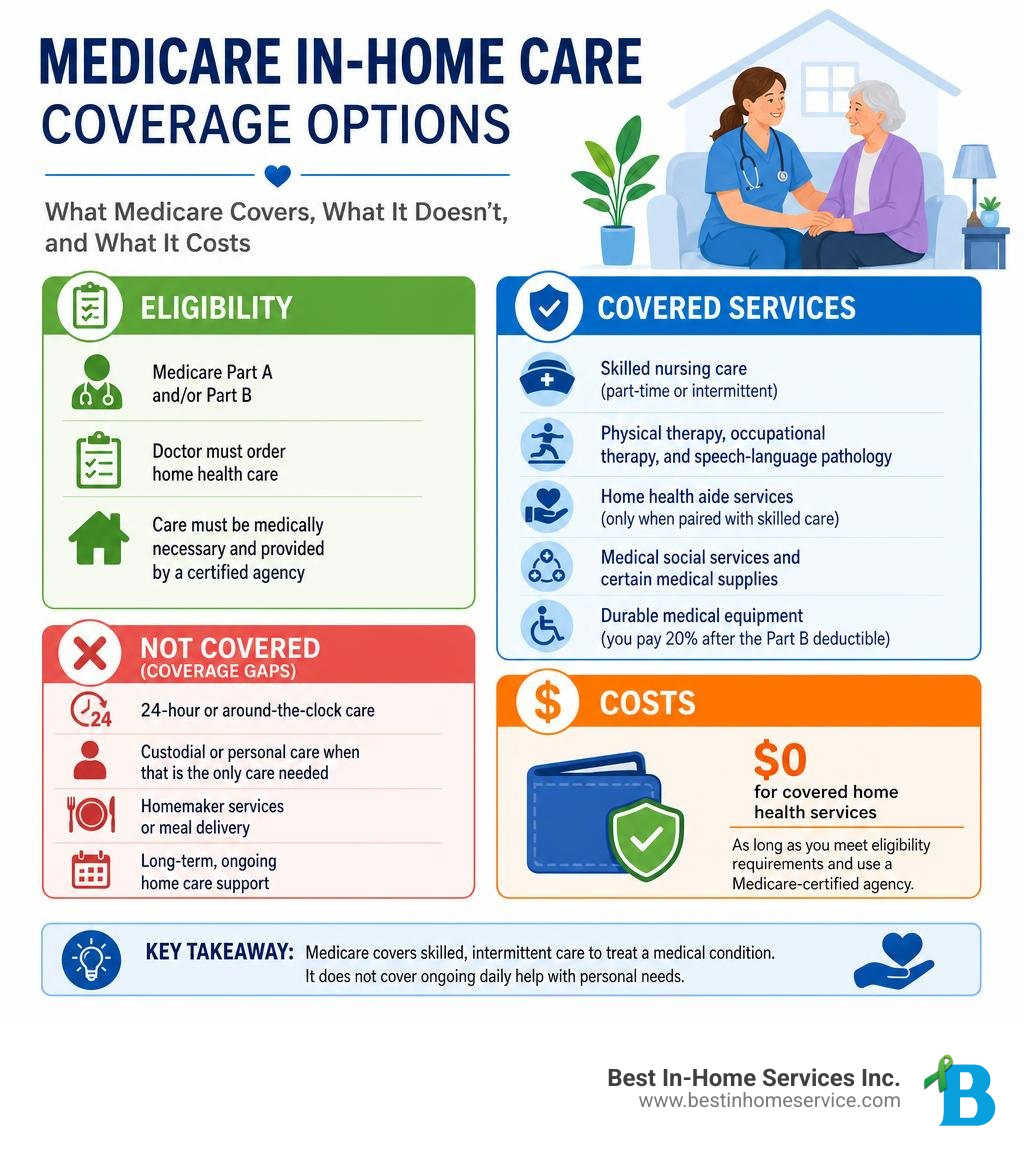
What Medicare covers at home:
- Skilled nursing care (part-time or intermittent)
- Physical therapy, occupational therapy, and speech-language pathology
- Home health aide services (only when paired with skilled care)
- Medical social services and certain medical supplies
- Durable medical equipment (you pay 20% after the Part B deductible)
What Medicare does NOT cover:
- 24-hour or around-the-clock care
- Custodial or personal care when that is the only care needed
- Homemaker services or meal delivery
- Long-term, ongoing home care support
The cost: $0 for covered home health services — as long as you meet eligibility requirements and use a Medicare-certified agency.
Figuring out how to pay for in-home care is one of the most stressful parts of helping an aging parent or loved one stay safe at home. For millions of older adults and people with disabilities, staying in a familiar environment is not just a preference — their well-being. And yet, the rules around what Medicare actually pays for are confusing, full of gaps, and often misunderstood.
More than 67 million Americans rely on Medicare, but many are surprised to learn that it doesn’t cover the kind of ongoing daily support that families often need most. Knowing exactly where Medicare helps — and where it stops — is the first step to building a care plan that works financially.
I’m Lily Harrison, General Manager at Best In-Home Services Inc., where I’ve spent years helping Chicago-area families navigate Medicare in home care coverage while coordinating compassionate, certified care for seniors with dementia, memory issues, and daily support needs. In the sections below, I’ll walk you through everything you need to know to make informed decisions for your loved one.
Understanding Medicare in Home Care: Coverage and Benefits
To make the most of your benefits, we must first look at what Medicare actually covers under the umbrella of “home health services.” This is medical care prescribed by a physician to help a patient recover from an illness, injury, or surgery, or to manage a chronic condition.

When you qualify, Medicare covers a specific range of services to help you regain independence. According to the official Home Health Services Coverage – Medicare guidelines, these covered services include:
- Skilled Nursing Care: This must be part-time or intermittent. It includes tasks that only a licensed nurse can perform, such as wound care, administering intravenous drugs, managing complex medications, and monitoring vital signs.
- Physical Therapy: Specialized therapy to help you rebuild strength, improve balance, and regain mobility after a fall, joint replacement, or stroke.
- Occupational Therapy: Therapeutic support to help you relearn how to perform everyday tasks, such as eating, dressing, and bathing safely.
- Speech-Language Pathology: Therapy designed to address speech, communication, or swallowing disorders.
- Home Health Aide Services: If—and only if—you are already receiving skilled nursing or therapy services, Medicare will cover part-time personal care assistance. This includes help with bathing, dressing, and using the bathroom.
- Medical Social Services: Counseling and social work support to help you and your family cope with the emotional and social challenges of your medical condition.
It is important to remember that Medicare-covered home health care is primarily restorative. It is designed to help you transition back to independent living or manage a specific medical event. For a deeper look at what to expect when returning home from a medical facility, check out our guide on A Guide to Post Hospitalisation Care and Recovery.
Eligibility Requirements for Medicare in Home Care
Getting Medicare to cover these services isn’t automatic. You must meet strict federal criteria to qualify. We often see families in the Chicago area assume their loved one is covered, only to find out they missed a key clinical requirement.
To receive Medicare in home care benefits, you must meet all of the following conditions:
- You must be homebound. This is the most critical hurdle. Under Medicare rules, “homebound” means leaving your home requires a major, taxing effort. You typically need the assistance of a wheelchair, walker, crutches, or another person to leave. While you can leave home for infrequent, short periods—such as attending a religious service, getting a haircut, or visiting the doctor—your primary status must be that leaving is highly difficult.
- You must need skilled care. You must require intermittent skilled nursing care, physical therapy, speech-language pathology, or have a continuing need for occupational therapy.
- A doctor must certify your need. A physician (or an allowed primary care practitioner) must sign a home health certification stating that you need these services and that a plan of care has been established.
- You must have a face-to-face assessment. You must meet with your doctor in person (or via approved telehealth) either in the 90 days before your home health care starts, or within 30 days after it begins. This meeting must focus specifically on the reason you need home care.
- You must use a Medicare-certified agency. The home health agency providing your care must be officially certified by Medicare.
Navigating these rules can feel like learning a foreign language. If you are trying to figure out how these pieces fit together for your family, read our practical breakdown of Navigating Home Health Care for step-by-step guidance.
Limitations and Exclusions of Medicare in Home Care
While Medicare provides incredible support for acute medical recoveries, it is not designed to be a long-term care solution. This is where many families experience a rude awakening.
Here is a list of what Medicare absolutely does not cover:
- 24-Hour Care: Medicare will not pay for around-the-clock supervision or care at home.
- Custodial Care: If your loved one only needs help with “activities of daily living” (ADLs)—such as bathing, dressing, eating, or using the bathroom—and does not require skilled medical care, Medicare will not pay a single penny.
- Meal Delivery: Services that deliver hot meals to your door (like Meals on Wheels) are not covered.
- Homemaker Services: General household help, including laundry, light housekeeping, grocery shopping, and running errands, is excluded if it is the only care you need.
If your family is dealing with a serious chronic illness or cognitive decline, you may find that your senior needs continuous supervision that goes far beyond what Medicare allows. In these situations, families often look to private duty options. For more information on securing continuous assistance, read about 24 Hour In Home Care in Illinois: Essential Support for Recovery.
Comparing Medicare and Medicaid HCBS for Long-Term Care
Because Medicare’s home health benefits are so strictly limited to short-term, skilled medical needs, many seniors eventually turn to Medicaid for long-term care. Specifically, Medicaid offers Home and Community-Based Services (HCBS) waivers designed to keep seniors out of nursing homes.
In Illinois, the primary program for this is managed through the Illinois Department on Aging – Community Care Program.
Understanding the differences between these two programs is crucial for long-term financial planning:
| Feature | Medicare Home Health Care | Medicaid HCBS (Community Care Program) |
|---|---|---|
| Primary Goal | Short-term medical recovery and rehabilitation | Long-term support to prevent nursing home placement |
| Care Type Covered | Skilled medical care (nursing, physical therapy) | Custodial care (bathing, housekeeping, meal prep) |
| Eligibility Criteria | Clinical (must be homebound and need skilled care) | Financial (strict low-income and asset limits) + physical need |
| Duration | Short-term (60-day renewable certification periods) | Long-term, ongoing support |
| Cost to Beneficiary | $0 for covered services (20% for medical equipment) | $0 or small copay based on income |
While the Medicaid Community Care Program is an excellent resource for low-income seniors in Chicago, Downers Grove, and Winnetka, the financial eligibility requirements are strict. For families who do not qualify for Medicaid but cannot rely on Medicare for daily personal care, private-pay home care is often the safest and most reliable path forward.
Out-of-Pocket Costs and Managing the Financial Burden
If your doctor prescribes home health care and you meet all the eligibility criteria, the actual visits from nurses or therapists are covered 100% by Medicare. You pay a $0 copayment.
However, there are still potential out-of-pocket costs that can sneak up on you:

- Durable Medical Equipment (DME): If you need a wheelchair, walker, hospital bed, or oxygen equipment at home, this is covered under Medicare Part B. After you meet your annual Part B deductible, you must pay a 20% coinsurance of the Medicare-approved amount for the equipment.
- Non-Covered Services: If you require additional help with meal preparation, companionship, or overnight supervision, you must pay for these services entirely out of pocket.
- Medicare Advantage Plans: If you have a private Medicare Advantage plan instead of Original Medicare, your plan may have different copays, prior authorization rules, or a specific network of home health agencies you must use.
To help manage these expenses, many seniors use Medigap (Medicare Supplement Insurance) to cover the 20% coinsurance for medical equipment. Others rely on long-term care insurance or private savings. If you are trying to budget for your loved one’s daily care without draining your life savings, check out our practical tips on Affordable Home Care for Seniors in Chicago.
Challenges in Accessing Home Health Care and How to Navigate Them
Even if you meet every single requirement on paper, actually securing medicare in home care can be surprisingly difficult in 2026.
The home health landscape has faced significant hurdles over the last decade. Several major factors are making it harder for seniors to get the care they need:
- Agency Shortages: The number of certified home health agencies (HHAs) has consistently decreased since 2013. This contraction is driven by changing reimbursement models and severe staffing shortages in the healthcare industry.
- Geographic Disparities: Research shows that economically disadvantaged neighborhoods have even more limited access to home health resources and Medicare-covered providers. If you live in certain parts of Cook County or DuPage County, finding an available agency with open staff slots can take weeks.
- Declining Completion Rates: Because agencies are stretched thin, rates of home health care completion have dropped among Medicare beneficiaries whose doctors recommended home-based care after a hospital stay. Many seniors are discharged with a home care plan, only to have the services fall through or end prematurely.
To protect your loved one, you must be proactive. If your family member is currently in the hospital, work closely with the hospital discharge planner as early as possible. Do not wait until the day of discharge to find an agency.
You can search for certified providers in your exact Illinois ZIP code using the official Find home health services near me – Medicare tool. To ensure you don’t face gaps in care when leaving the hospital, read our guide on Post Hospital Discharge: Essential Tips for a Smooth Transition Home.
Frequently Asked Questions about Home Care Costs
How long will Medicare pay for in-home health services?
Medicare covers home health services in 60-day episodes. There is no lifetime limit on how many 60-day periods you can receive. Your doctor can renew the plan of care and recertify your need for additional 60-day periods indefinitely, as long as you continue to meet the eligibility requirements (including being homebound and needing intermittent skilled care).
However, “intermittent” care is strictly defined. It generally means up to 8 hours of care per day combined, for a maximum of 28 hours per week. In some cases, Medicare may allow up to 35 hours a week for short periods if your doctor can demonstrate an exceptional medical necessity. If your loved one is recovering from a surgical procedure, you can read more about what to expect during this recovery window in our article Post Hospital Care Throughout Illinois: What to Expect from Home Care After Surgery.
What is the difference between medical home health and non-medical home care?
This is the single most common source of confusion for families.
- Medical Home Health Care: This is clinical, skilled medical care prescribed by a doctor and covered by Medicare. It includes wound care, physical therapy, and injections. It is provided by licensed medical professionals (RNs, LPNs, PTs) and is always short-term and intermittent.
- Non-Medical Home Care (Personal Care): This is non-clinical support that helps seniors safely age in place. It includes dementia care, companionship, light housekeeping, meal preparation, and help with bathing and dressing. This care is typically paid for out of pocket (private pay), through long-term care insurance, or via Medicaid waivers.
At Best In-Home Services Inc., we specialize in providing this highly customized, non-medical support. To see how we tailor our services to your family’s unique routine, explore Our Personalized Home Care Services.
How do I find a Medicare-certified home health agency near me?
You can use the Medicare Care Compare tool on the official Medicare website to search by your ZIP code. Additionally, you should ask your doctor, hospital discharge planner, or social worker for a list of certified agencies that service your specific area in Illinois.
If you are looking for a comprehensive list of care options and want to understand how different agencies operate in the local area, you can read our breakdown of The Best Home Care Agencies in Chicago.
Conclusion
Understanding medicare in home care is all about knowing where the clinical boundaries lie. Medicare is an invaluable resource for short-term medical rehabilitation, but when your loved one needs continuous, daily support to cope with dementia, physical frailty, or memory loss, you need a partner who can fill the gaps.
At Best In-Home Services Inc., we provide personalized, 24/7 in-home elder care across Chicago, Downers Grove, Winnetka, and the surrounding Chicagoland suburbs. Our certified staff is trained to handle complex memory care, personal care, and daily household needs, ensuring your loved one can age in place with dignity and safety.
If you are realizing that Medicare won’t cover the full scope of care your family needs, you don’t have to navigate this journey alone. Read more about Why Senior Care at Home is the Best Choice for Aging in Place, or reach out to us today to Explore our personalized home care services and build a custom care plan that fits your budget.







 1-224-636-5200
 1-224-636-5210
  425 Huehl Rd 13B Northbrook IL 60062