
Why Choosing the Right In Home Care Providers Can Change Everything
In-home care providers give families a way to get real, daily support for a loved one — without uprooting them from their own home.
If you need a quick answer, here’s what to know:
What to look for in an in-home care provider:
- Licensed and insured — the agency carries proper state licensure and worker insurance
- Screened caregivers — background checks, reference checks, and TB assessments completed before hire
- Custom care plan — written plan developed after a home assessment, not a one-size-fits-all approach
- Backup coverage — a named policy for when a regular caregiver can’t make a shift
- Clear communication — families can monitor care through a portal, phone updates, or written notes
- Flexible scheduling — hourly, overnight, or 24/7 options depending on need
- Specialized support — dementia care, post-hospital recovery, and end-of-life care handled by trained staff
But picking the right agency is harder than it looks.
You’re not just hiring a service. You’re trusting a stranger with someone you love. And in a market this crowded — the Bureau of Labor Statistics projects 765,800 home care job openings per year through 2034 — it’s easy to feel overwhelmed fast.
The options range from large national networks to small local agencies. Some are licensed and rigorous. Others are not. Some match caregivers by personality and condition. Others send whoever is available.
Families in Chicago face this choice constantly — and often during some of the most stressful moments of their lives: after a hospital discharge, after a fall, or after a dementia diagnosis finally makes living alone unsafe.
This guide cuts through the noise. It explains what in-home care providers actually do, how to evaluate them, what questions to ask, and how to get started without second-guessing every step.
I’m Lily Harrison, General Manager at Best In-Home Services Inc., where I coordinate personalized care for Chicago-area families navigating decisions about in-home care providers for seniors dealing with dementia, memory challenges, and daily living needs. With years of hands-on experience matching families with certified caregivers, I’ve seen what separates agencies that truly support families from those that fall short.
What In Home Care Providers Actually Do
When we talk about in home care providers, we are describing a wide net of support designed to keep people safe and happy in their own residences. This isn’t just about “watching” someone; it’s about active engagement, safety monitoring, and physical assistance.
The goal of these services is to bridge the gap between complete independence and the need for a facility. Whether it is help with individual services like meal prep or more intensive support for chronic illnesses, these providers act as the “boots on the ground” for families who can’t be there 24/7.
What services in home care providers typically offer
The core of what in home care providers do falls into a few main buckets:
- Personal Care: This is the hands-on help. It includes bathing, dressing, grooming, and toileting. It also involves “ambulation”—a fancy word for helping your loved one walk or move from the bed to a chair safely.
- Companion Care: Loneliness is a health risk. Companions provide conversation, social interaction, and emotional support.
- Homemaker Services: This keeps the house running. Think light housekeeping, laundry, and running errands.
- Health Maintenance: While non-medical, providers offer medication reminders, appointment assistance, and meal preparation to ensure nutrition and hydration stay on track.

How in home care providers differ from home health agencies
One of the biggest points of confusion for families is the difference between “home care” and “home health.” While they sound similar, they are regulated very differently in Illinois.
| Feature | In-Home Care (Non-Medical) | Home Health (Clinical) |
|---|---|---|
| Primary Goal | Assistance with daily living (ADLs) | Medical recovery and treatment |
| Staff | Caregivers, Companions, CNAs | Registered Nurses, PTs, OTs |
| Orders | No doctor’s order required | Requires physician’s orders |
| Payment | Private pay, LTC insurance, VA | Medicare, Private Insurance |
| Services | Meal prep, bathing, companionship | Wound care, injections, therapy |
For a deeper dive into these distinctions, you can check our guide on navigating home health care.
Who benefits most from care at home
In-home care isn’t just for the elderly. While seniors aging in place are the primary group, many others thrive with this support:
- Disabled Adults: Those needing help with mobility or household tasks to maintain autonomy.
- Post-Surgery Patients: People coming home from the hospital who need a few weeks of help with bathing and meals.
- Dementia Patients: Individuals who need a familiar environment to reduce “sundowning” and confusion.
- Family Caregivers: Those on the verge of burnout who need respite care to recharge.
We believe why senior care at home is the best choice for aging in place comes down to dignity. It allows your loved one to keep their own schedule, eat their own food, and sleep in their own bed.
How to Evaluate In Home Care Providers Like a Pro
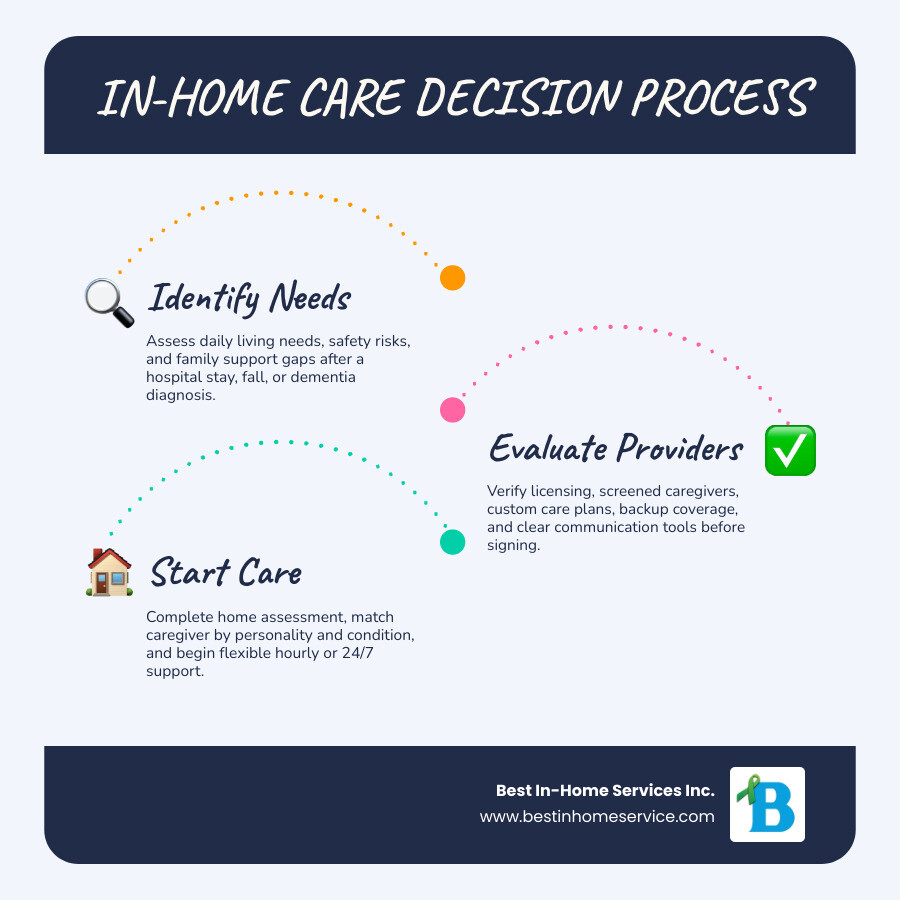
Evaluating an agency shouldn’t feel like a guessing game. You need a systematic way to peel back the layers of marketing and see how the agency actually operates on a Tuesday at 2:00 AM.
The must-ask questions before you sign anything
We always tell families to treat the initial consultation like a high-stakes interview. You aren’t being “difficult” by asking these; you are being diligent.
- How do you screen your staff? Do they do criminal background checks, identity verification, and TB screening?
- What is your training process? Are they certified? Do they have specific training for dementia or Parkinson’s?
- What is your backup policy? If a caregiver’s car breaks down, who shows up?
- How do you handle supervision? Does a nurse or supervisor check in periodically?
- How do we communicate? Is there a portal or a logbook?
Finding the perfect match among professional caregivers for seniors is about more than just a resume; it’s about personality and trust.
Red flags that signal a risky agency
If you encounter these during your search, proceed with extreme caution:
- The “Vague Answer” Specialist: If they can’t explain their billing or screening process clearly, they likely don’t have one.
- No Written Care Plan: Every client needs a roadmap. If they say, “We just do whatever is needed,” that’s a recipe for missed medications and confusion.
- Contractors vs. Employees: If the agency uses 1099 contractors, they often have less control over training and scheduling, and you might be liable for certain taxes or injuries.
- High Pressure: If they try to force a 24-hour contract before even meeting your loved one, walk away.

What good agencies do differently
The best in home care providers focus on the “human” side of the data. At Best In-Home Services Inc., we prioritize why choose BIHS by focusing on 24/7 support and continuity of care. A “good” agency doesn’t just fill a shift; they match a caregiver’s personality to the senior’s interests. They provide nurse oversight and regular reassessments to ensure that as a senior’s needs change, the care plan changes with them.
Licensing, Regulation, and Screening: Why the Rules Matter
In Illinois, the rules are there to protect your family. An unlicensed provider is a massive legal and safety risk.
How in-home care is licensed and regulated across states
While some states have lax rules, Illinois requires agencies to be licensed by the Illinois Department of Public Health (IDPH). This ensures the agency follows specific standards for “Home Services.” These regulations cover everything from how records are kept to how complaints are handled. If an agency isn’t licensed, they aren’t being inspected, and there is no governing body to help you if things go wrong.
Screening standards families should verify
Don’t just take an agency’s word for it. Verify that they follow these standards:
- Criminal Background Checks: Mandatory for all direct care staff.
- TB Risk Assessment: Ensuring the caregiver is healthy and safe to be in the home.
- Identity Verification: Making sure the person on the ID is the person in the house.
- Insurance and Bonding: This protects you if something is broken or stolen.
You can view our commitment to these standards on our certifications page.
How to verify a provider in Illinois
If you are in the Chicago area, you have several resources to check legitimacy:
- IDPH Web Portal: Search for licensed home service agencies.
- Medicare Compare: While primarily for home health, it can help you find reputable organizations.
- Local Resources: Check the Home Health Care Agencies in Chicago and Illinois list or look into Community Services Programs in DuPage County for local guidance.
Paying for Care Without Guesswork
The “how much does it cost” question is usually the first one on a family’s mind. In-home care is generally billed hourly, though 24-hour and live-in rates exist.
What private pay usually covers
Most families pay for in home care providers out of pocket. This “private pay” model offers the most flexibility. You can choose your hours, the specific caregiver, an
d the tasks performed. Rates in the Chicago suburbs — including Naperville and Northbrook — vary with the complexity of care. At Best In-Home Service, Inc., companion and homemaker care is $35 per hour, personal care assistance and respite care are $37 per hour, overnight and weekend care are $40 per hour, dementia and Alzheimer’s care is $42 per hour, and holiday care is $45 per hour. A 3-hour minimum applies per visit, and continuous 24-hour care is quoted at a customized rate. Mileage for transportation is billed separately at $0.75 per mile.
Medicaid, IHSS, and other public programs explained
For those with limited assets, public programs can help.
- IHSS (In-Home Supportive Services): While this is a major program in California, Illinois has similar “Waiver” programs through Medicaid (like the Community Care Program) that help seniors stay home.
- Eligibility: Usually requires a “determination of need” (DON) score and meeting specific income/asset limits.
- Reassessment: You have the right to request a reassessment if your loved one’s health declines.
Long-term care insurance and VA benefits
If your loved one has a Long-Term Care (LTC) insurance policy, it likely covers in-home care once an “elimination period” is met.
- VA Benefits: Veterans and their surviving spouses may qualify for “Aid and Attendance” benefits, which provide a monthly stipend specifically for home care.
- Paperwork: These programs are paperwork-intensive. We often recommend getting a free assessment to help determine how your specific needs align with your policy.
Why in-home care can cost less than facility care
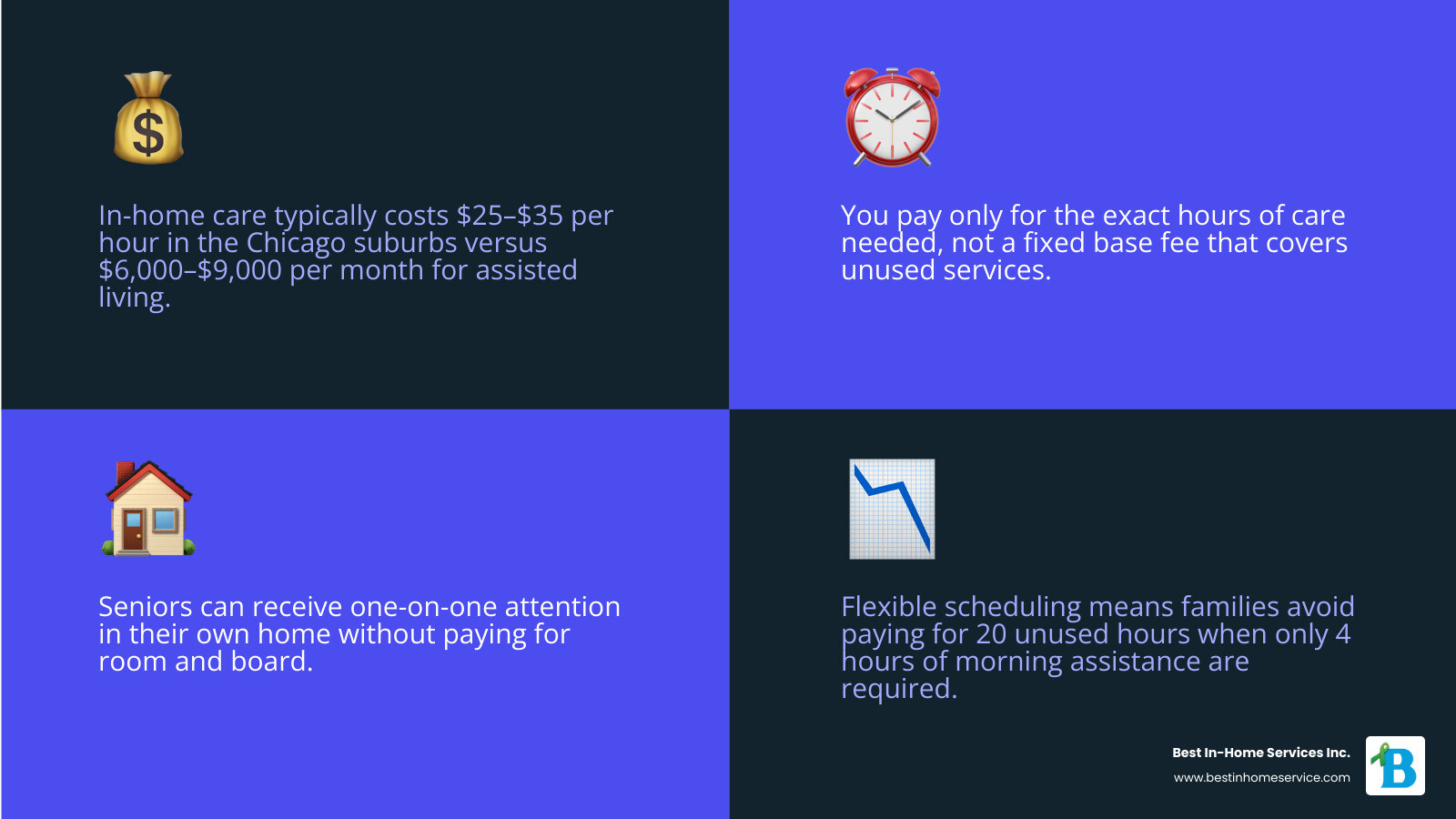
When you compare home care vs assisted living, home care is often the winner for the budget. In a facility, you pay for the room, the board, and a base level of care regardless of whether you use it. With in-home care, you only pay for the hours you need. If Mom only needs help for 4 hours in the morning to get dressed and eat, you aren’t paying for the other 20 hours.
Specialized Care Needs: When Basic Help Is Not Enough
Sometimes, the needs go beyond light housekeeping. This is where specialized in home care providers prove their worth.
Dementia and memory support at home
Caring for someone with Alzheimer’s requires a specific skillset. It’s about more than safety; it’s about managing personality changes and preventing wandering.
- Consistency: Having the same caregiver reduces anxiety.
- Routine: Caregivers help maintain a strict schedule to minimize confusion.
For more details, see our guide on understanding memory care or our deep dive into dementia care in your own home.
Post-hospital and recovery care
The first 72 hours after leaving a hospital are the most dangerous for seniors. This is when medication errors and falls happen.
- Discharge Planning: We help transition the clinical notes into a daily routine.
- Readmission Prevention: By monitoring vitals and ensuring follow-up appointments are kept, caregivers keep seniors out of the ER.
Check out our post-hospital discharge tips and learn about 24-hour in-home care in Illinois for recovery.
End-of-life, respite, and caregiver relief
Hospice care focuses on comfort, and our caregivers work alongside hospice nurses to provide the 24/7 presence that nurses cannot. We also provide “respite” care—giving the daughter or son who has been doing it all a chance to sleep, shower, or take a vacation without guilt.
How to Get Started With an In-Home Care Provider
The process from “we need help” to a caregiver walking through the door is faster than you might think—often within 48 to 72 hours.
The typical process from first call to first shift
- Initial Inquiry: You call and describe the situation.
- Home Assessment: A care coordinator visits the home to check for fall hazards and meet the senior.
- Care Plan Design: We create a written schedule and task list.
- Caregiver Match: We select a staff member based on skills and personality.
- Trial Shift: The first visit where everyone gets acquainted.
For a no-stress experience, look at our Chicago home care agency shortlist.
What to prepare before the assessment
To make the most of your consultation, have these ready:
- List of ADLs: What can they do? What can’t they do?
- Medication List: Including dosages and times.
- Home Hazards: Are there steep stairs? Loose rugs?
- Emergency Contacts: Who do we call first?
You can find many of the necessary forms on our site to get a head start.
How families in Chicago-area communities can narrow the search
Location matters. You want an agency that has a strong presence in your specific neighborhood to ensure backup caregivers can arrive quickly. We serve a wide range of communities, including:
Whether you are in the city or the suburbs like Buffalo Grove or Des Plaines, local knowledge of the hospitals and pharmacies in your area makes a difference.
Frequently Asked Questions about In Home Care Providers
What is the In-Home Supportive Services (IHSS) program and who qualifies for it?
IHSS is a California-specific program. However, in Illinois, similar Medicaid-funded programs exist for those who are 65+, blind, or disabled and meet asset requirements. These programs pay for caregivers to help with household tasks so the individual can stay out of a nursing home.
Will insurance or Medicare pay for in-home care providers?
Generally, no. Medicare pays for “skilled” care (nursing/therapy) but not “custodial” care (bathing/meal prep). Long-term care insurance and certain VA benefits are the primary insurance-based payers for in-home care.
How quickly can care begin after I contact an agency?
In urgent situations, such as a surprise hospital discharge, care can often begin within 24 to 48 hours once the assessment is complete.
Conclusion
Choosing between various in home care providers is a big decision, but it doesn’t have to be a source of “losing your mind.” By focusing on licensing, custom care plans, and clear communication, you can find a partner that brings peace of mind back to your family.
At Best In-Home Services Inc., we are committed to providing the highest level of certified, 24/7 support across the Chicago area. If you’re ready to see how a personalized care plan can help your loved one thrive at home, explore our full range of services or contact us today for a consultation.







 1-224-636-5200
 1-224-636-5210
  425 Huehl Rd 13B Northbrook IL 60062