
How to Become a Paid Family Caregiver Through DSHS
To become a DSHS caregiver for a family member, the person needing support must first apply for state Medicaid long-term care services and undergo a functional assessment. Once approved, an eligible relative can register as a paid Individual Provider, pass mandatory background checks, complete state-approved orientation and training, and provide authorized personal care hours at home. While spouses and parents of minor children face specific state exclusions, adult children, siblings, and extended family members commonly qualify for state-funded compensation.
Families in Illinois researching this type of state-funded family caregiving often want to understand how Washington’s Department of Social and Health Services (DSHS) framework compares with options closer to home through the Illinois Department of Human Services (IDHS) and the Illinois Department on Aging. Best In-Home Service Inc. is an Illinois-licensed non-medical home care agency (License #3000758) based in Northbrook, supporting families throughout Chicago, Cook County, Lake County, and DuPage County with professional caregiving guidance and private-pay in-home support for those who do not qualify for, or prefer not to use, state-administered family caregiver programs.
More about senior in home care vocab explained:
Becoming a DSHS Caregiver for a Family Member: Eligibility and Requirements
Across the country, hundreds of thousands of family members provide unpaid daily assistance to aging parents and disabled relatives. State-funded Medicaid Long-Term Services and Supports (LTSS) allow eligible individuals to transition from informal helpers into formally compensated caregivers.
Under state programs such as Washington’s DSHS system and comparable Department of Human Services programs in Illinois, family members who provide routine assistance can be hired as Individual Providers (IPs). In Washington, Consumer Direct Care Network Washington (CDWA) acts as the Consumer Directed Employer handling payroll and screening. Through programs detailed by Paid Family Caregivers, qualified relatives receive hourly wages funded by Medicaid LTSS to deliver non-medical personal care at home.
Who Qualifies as a DSHS Caregiver for Family Member Roles?
State social and health service programs allow a wide circle of relatives to serve as paid caregivers. You may qualify if you are:
- An adult child caring for an aging parent
- A parent caring for an adult child (age 18 or older) with physical or developmental disabilities
- A sibling caring for a brother or sister
- Extended family members, including aunts, uncles, nieces, nephews, cousins, grandparents, and in-laws
To qualify as a paid provider, you must be at least 18 years old, possess valid photo identification, hold legal authorization to work in the United States, and pass a state criminal background check including fingerprinting.
Exceptions for Spouses and Parents of Minors
Medicaid regulations generally maintain strict boundaries regarding legal financial support obligations:
- Spouses: Under standard Medicaid personal care programs, spouses are generally excluded from receiving state caregiver wages. However, alternative routes exist, including Veteran Directed Care programs and specific state trust distributions such as the WA Cares Fund.
- Parents of Minors: Biological and adoptive parents cannot receive Medicaid personal care wages for children under 18 due to legal parental support obligations. Minor children may still receive approved medical equipment, nursing support, or therapy benefits.
For families navigating care boundaries, resources like 22-1332 Hiring Family or Friends as Your Caregiver provide guidance on setting schedules and arranging backup care.
Care Recipient Financial and Functional Criteria
Before a family member can be hired, the care recipient must qualify for Medicaid LTSS based on financial and functional standards:
- Financial Thresholds (2026): For an individual applicant, countable monthly income cannot exceed $2,982 (the Special Income Level standard), with countable liquid assets generally capped at $2,000.
- Functional Requirements: A state case manager evaluates the applicant’s ability to perform activities of daily living (ADLs), such as bathing, dressing, transferring, mobility, toileting, and eating. Qualification typically requires hands-on assistance with at least two core ADLs.
Families reviewing these standards can consult navigating home care help for aging parents to better understand assessment processes and care hour allotments.
Step-by-Step Enrollment and Training Requirements
Enrolling as a state-funded caregiver involves a coordinated process between the recipient’s local Department of Social and Health Services (DSHS) office and CDWA.
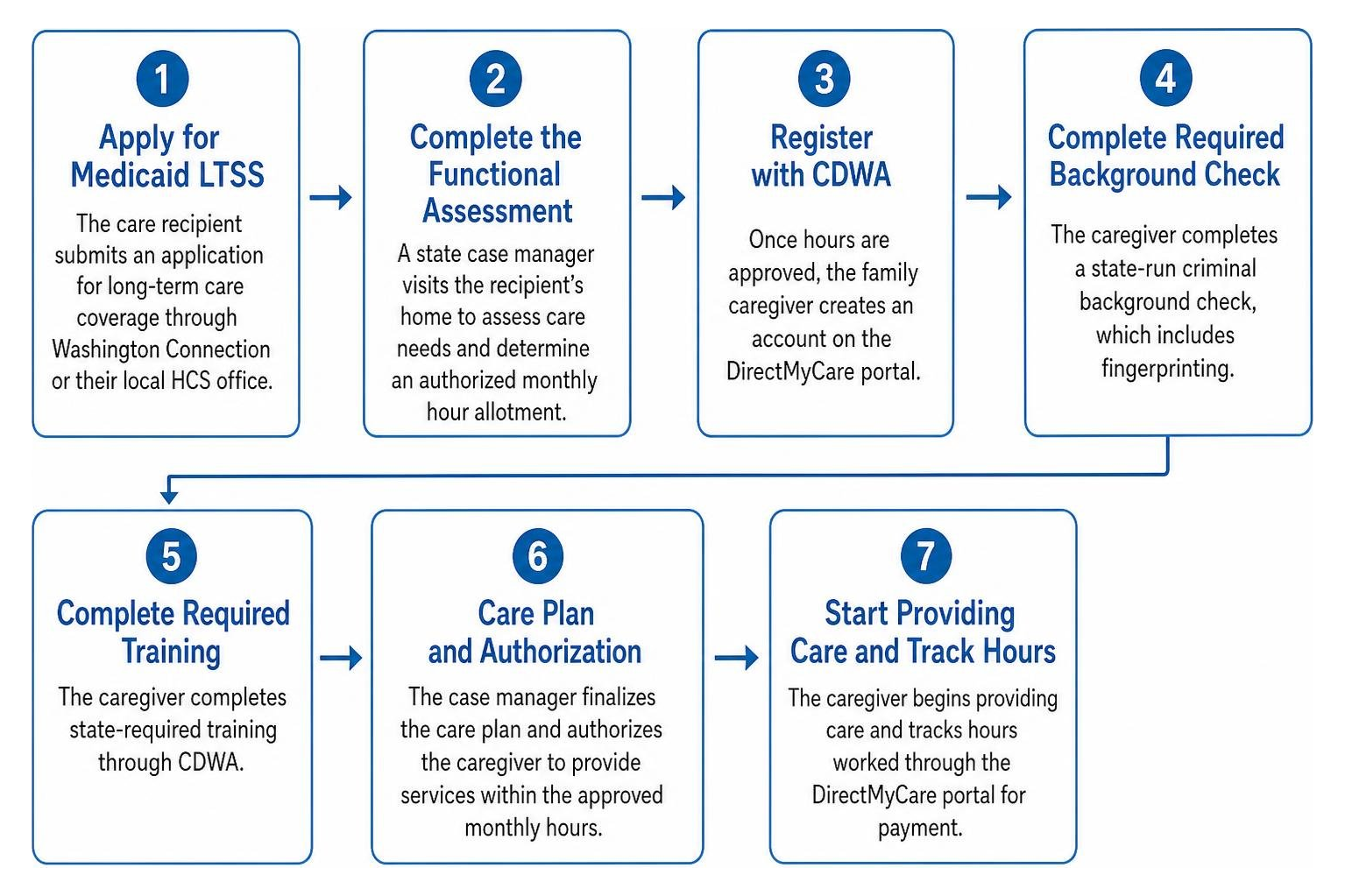
Step-by-Step Application Process for a DSHS Caregiver for Family Member
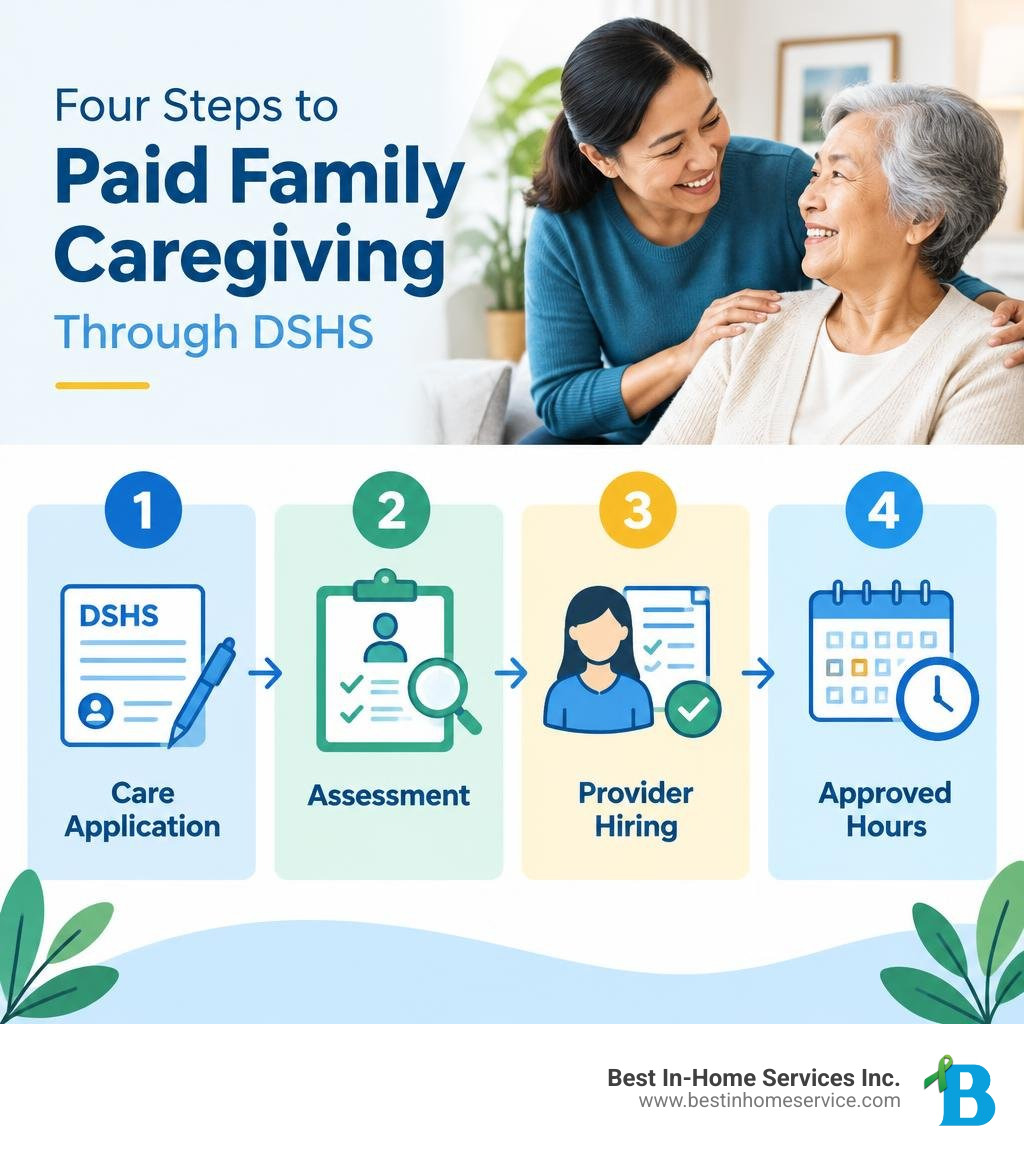
- Apply for Medicaid LTSS: The care recipient submits an application for long-term care coverage through Washington Connection or their local Home and Community Services (HCS) office.
- Complete the Functional Assessment: A state case manager visits the recipient’s home to assess care needs and determine an authorized monthly hour allotment.
- Register with CDWA: Once hours are approved, the family caregiver creates an account on the DirectMyCare portal.
- Submit Background Checks and Paperwork: Complete the state background authorization form, submit work authorization documents, and schedule required fingerprinting.
- Finish Initial Orientation: Complete the mandatory 5-hour orientation and safety training module online.
- Receive Service Authorization: Once CDWA issues an official start date, log time through the electronic visit verification portal.
For an in-depth walkthrough of these enrollment milestones, review How to Apply to Be a Paid Family Caregiver in Washington – LegalClarity.

Training Hours and Home Care Aide Certification
Caregivers must complete specific training pathways administered through the SEIU 775 Benefits Group:
- Paid Family Caregivers (Limited Enrollment): Most family members caring solely for an eligible relative must complete 35 hours of training within 120 days of hire. This includes the 5-hour Orientation and Safety class plus 30 hours of Basic Training.
- Home Care Aides (Standard Track): Non-family caregivers and general home care aides must complete 75 hours of training and pass state written and skills exams through the Department of Health within 365 days of hire.
Annual Continuing Education Obligations
To keep credentials active, Individual Providers must complete 12 hours of Continuing Education (CE) each year.
- Deadline: CE courses must be completed before your birthday each calendar year.
- Compliance Rules: Missing this deadline leads to immediate payment suspension until the hours are completed.
- Exemptions: Parents who serve as Individual Providers exclusively for their adult children are generally exempt from annual CE mandates unless they hold a separate Home Care Aide certification.
You can verify your specific training requirements through the official Continuing Education Requirements | DSHS portal.
Pay Rates, Authorized Hours, and Caregiver Compensation
Individual Provider pay rates in Washington are established through the SEIU 775 collective bargaining agreement. Hourly compensation exceeds the standard state minimum wage ($17.13 per hour in 2026):
- Base Starting Pay (2026): Entry-level Individual Providers start at $22.63 per hour, with scheduled increases reaching $23.54 per hour.
- Experience Step Increases: Caregivers with accumulated hours can reach advanced pay tiers up to $27.28 per hour.
- Care Plan Hours: Pay is strictly capped at the number of monthly hours authorized by the DSHS case manager. Caregivers track and submit these hours electronically through CDWA’s DirectMyCare system.
| Caregiver Pathway | Required Training | Hourly Wage Range (2026) | Annual CE Requirement |
|---|---|---|---|
| Family Individual Provider | 35 hours (within 120 days) | $22.63 – $27.28 / hr | 12 hours (Exempt for parent IPs) |
| Certified Home Care Aide | 75 hours + State Exams | $22.63 – $27.28 / hr | 12 hours annually by birthday |
| Parent Individual Provider | 35 hours Basic Training | $22.63 – $27.28 / hr | None (unless certified as HCA) |
Tax Implications and Impact on Public Assistance
Earning income as a family caregiver can affect your income taxes and eligibility for other public benefit programs.
The Difficulty-of-Care Tax Exclusion
Under IRS Notice 2014-7, qualified Medicaid waiver payments can be excluded from federal gross income if the caregiver lives in the same primary residence as the care recipient:
- Wages are exempt from federal income tax withholding.
- You receive a W-2, but qualifying wages can be excluded on your federal tax return.
- If the caregiver does not live with the care recipient, wages are fully taxable under standard state and federal rules.
Social Security, SSI, and SNAP Considerations
Caregiving income counts as earned income for many public benefit calculations:
- Supplemental Security Income (SSI): If you receive SSI for your own disability, caregiving wages can reduce monthly benefits once earnings exceed substantial gainful activity limits ($1,690 per month in 2026).
- SNAP (Food Assistance): Caregiving earnings must be reported on SNAP applications, subject to standard 20% earned-income deductions and allowable household expenses.
For practical advice on managing home schedules and safeguarding assistance benefits, explore our comprehensive guide to reliable elder care.
State Support Programs and Alternative Caregiving Resources
Family members who do not qualify for direct Medicaid wages or who need supplementary respite support can access alternative state and local resources:
- Tailored Supports for Older Adults (TSOA): Designed for adults age 55 and older who do not qualify for full Medicaid in Washington. TSOA offers unpaid caregivers access to respite care, minor home modifications, specialized medical equipment, and support services. You can apply directly using the Application for Tailored Supports for Older Adults (TSOA) program.
- Family Caregiver Support Program (FCSP): Managed through local Area Agencies on Aging, this program provides caregiver counseling, support groups, and respite vouchers.
- CareLearn Washington & State Training Hubs: Online portals providing 24/7 caregiving education and disease-specific modules.
- DSHS Contacts: Regional office directories and enrollment assistance can be accessed through Contact the Department of Social and Health Services | DSHS and Caregiving Resources.
- Illinois Alternatives: Families in Cook, Lake, and DuPage counties can look into the Illinois Department on Aging’s Community Care Program and the Illinois Department of Human Services / Rehabilitation Services Home Service Program, both of which offer separate eligibility paths and in-home support options for older adults and adults with disabilities.
Frequently Asked Questions About State-Funded Family Caregiving
How much do state-funded family caregivers get paid per hour?
In 2026, Individual Providers in Washington earn starting base wages of $22.63 per hour under the SEIU 775 collective bargaining agreement, with scheduled increases to $23.54 per hour and senior tiers reaching up to $27.28 per hour.
Can I get paid to care for my spouse through state Medicaid programs?
Under standard Washington Apple Health Medicaid personal care programs, spouses are not eligible to receive wages as paid Individual Providers. Spouses may seek compensation through alternative pathways such as the federal Veteran Directed Care program or the WA Cares Fund.
What happens if I miss the continuing education deadline?
If an Individual Provider fails to complete their 12 required CE hours before their birthday, CDWA pauses timesheet authorization and payment. Payments resume once the caregiver completes the necessary hours through an approved training instructor.
Conclusion
Understanding state-funded caregiving options helps families balance hands-on support with sustainable financial planning. Whether you are comparing Washington’s Medicaid-based program with programs available closer to home or evaluating private support options in Illinois, having the right care framework protects both the individual receiving care and the family member providing it.
For families in Illinois seeking dependable support across Cook, Lake, and DuPage counties – including Chicago, Northbrook, Skokie, Evanston, Schaumburg, Naperville, and Highland Park – Best In-Home Service Inc. delivers personalized personal care services tailored to your family’s schedule.
Our agency is licensed by the Illinois Department of Public Health, approved by the Illinois Department on Aging under the Community Care Program, and recognized by the Illinois Department of Human Services / Rehabilitation Services for the Home Service Program. We provide non-medical assistance including respite care, dementia support, personal care assistance, meal preparation, mobility support, and transportation accompaniment.
To discuss care schedules or request a free assessment, call our team directly at 224-636-5200 or connect through our main portal.





 1-224-636-5200

 1-224-636-5210
 425 Huehl Rd 13B Northbrook IL 60062