
Why Respite Home Health Care Matters for Tired Family Caregivers
Respite home health care is a short-term care service where a trained professional steps in to look after your loved one — so you, the primary caregiver, can take a real break.
Here’s a quick overview:
| Question | Quick Answer |
|---|---|
| What is it? | Temporary relief care provided at home or in a facility |
| Who is it for? | Family caregivers of seniors, people with dementia, chronic illness, or disability |
| What’s included? | Personal care, medication reminders, meal prep, companionship, nursing |
| How long can it last? | A few hours, overnight, or up to several weeks |
| Is it covered? | Varies — public programs, insurance, and private pay options exist |
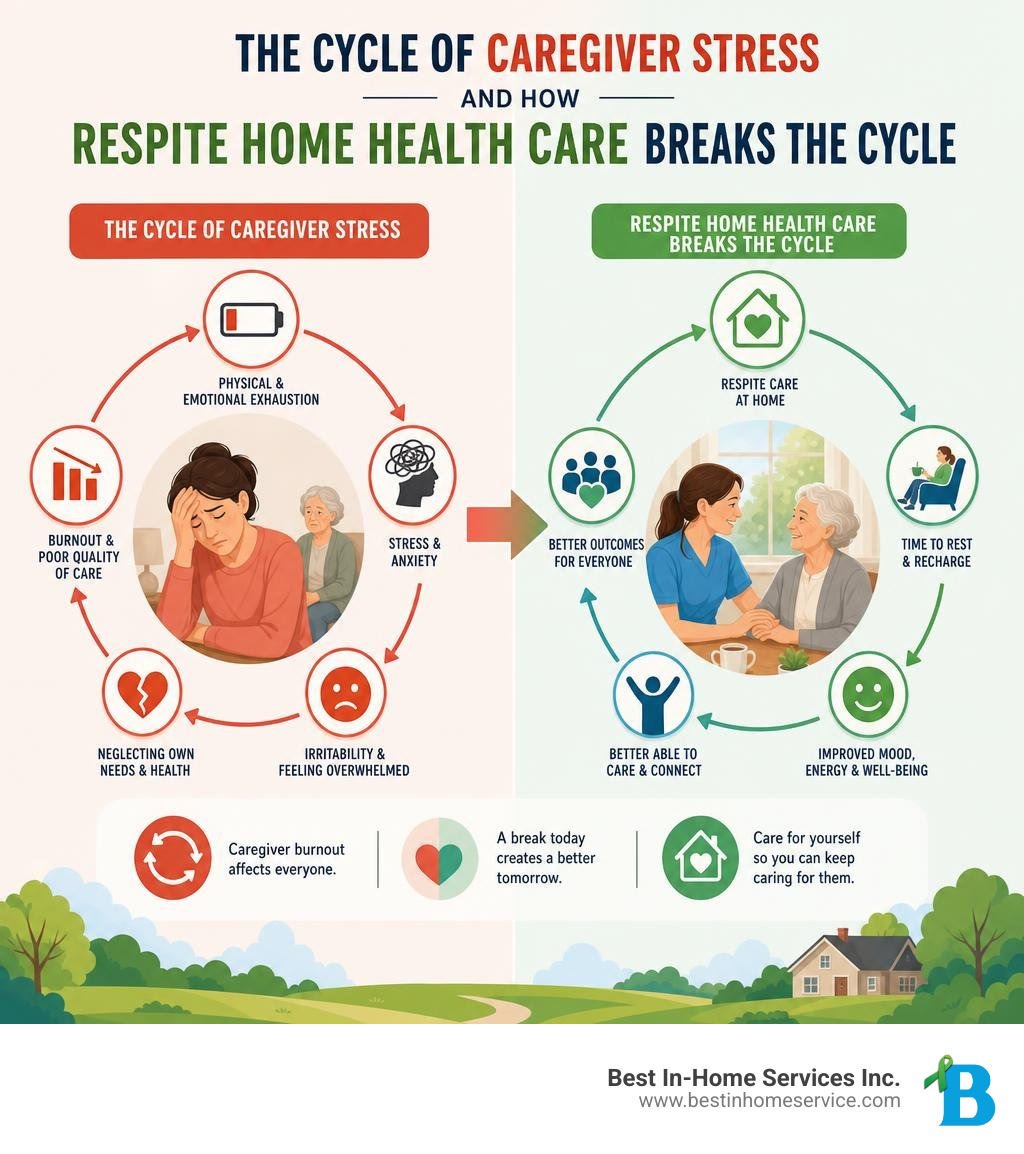
Caring for a loved one is one of the most selfless things a person can do. But it’s also exhausting — physically, emotionally, and mentally. Many family caregivers in Chicago are quietly running on empty, skipping their own doctor appointments, losing sleep, and feeling guilty for even wanting a break.
That guilt is normal. But it’s also dangerous. When caregivers burn out, the quality of care suffers — for everyone.
That’s exactly what respite care is designed to solve.
I’m Lily Harrison, General Manager at Best In-Home Services Inc., where I’ve spent years helping Chicago families navigate respite home health care options for seniors needing dementia support, daily assistance, and 24/7 care at home. In this guide, I’ll walk you through everything you need to know — from types of services to costs and how to get started.
What is Respite Home Health Care and How Does It Work?

At its core, respite home health care is a professional support system designed to give family caregivers a temporary break. It is not about replacing you or admitting defeat; it is about sustaining your ability to care for your loved one over the long haul.
When we step in to provide respite care, our certified caregivers ensure that your loved one’s daily routines remain completely uninterrupted. We match our caregivers to your family based on personality, experience, and your loved one’s specific medical or behavioral needs.
During a respite visit, a professional caregiver manages everything from safety monitoring and engagement to assistance with activities of daily living (ADLs). For seniors who simply need a friendly face to chat with, play cards, or go for a walk, we provide dedicated companionship. You can read more info about companion care services to see how a “professional bestie” can keep your loved one socially active while you take some much-needed time for yourself.
Defining Respite Home Health Care Services
Respite care services are highly flexible and can be customized to match the exact level of care your loved one requires. This ranges from basic companion support to advanced personal and clinical care:
- Companion Respite: Social engagement, safety supervision, light housekeeping, and meal preparation.
- Personal Care Respite: Hands-on assistance with bathing, dressing, grooming, and toileting. You can explore more info about personal care to understand how we maintain dignity and comfort during these sensitive tasks.
- Clinical Respite/Nursing Care: For individuals with complex medical needs, certified nursing assistants (CNAs) or registered nurses can administer medications, manage wound care, and monitor vital signs.
How Respite Care Differs from Standard Home Care
While standard home care is typically an ongoing, long-term commitment designed to help seniors age in place permanently, respite care is uniquely caregiver-centric and short-term.
Standard home care focuses almost entirely on the client’s long-term independence. Respite care, on the other hand, is scheduled around your calendar. Whether you need a few hours on a Tuesday afternoon to attend your own doctor’s appointment, a weekend off to attend a family wedding in Winnetka, or emergency same-day support due to an unexpected personal conflict, respite care adapts to your life. It provides a temporary safety net, allowing you to step away with complete peace of mind.
Types of Respite Care Services Available
To help you understand the different levels of support, we have broken down the primary distinctions between companion-based respite and hands-on personal respite care:
| Feature | Companion Respite Care | Personal Respite Care |
|---|---|---|
| Primary Focus | Socialization, safety, and basic household help | Hands-on physical assistance and hygiene |
| Typical Activities | Conversation, games, light meal prep, walks | Bathing, dressing, transferring, incontinence care |
| Level of Assistance | Standby supervision and cognitive engagement | Direct physical support and mobility assistance |
| Best For | Seniors who are lonely or unsafe when left alone | Individuals with limited mobility, chronic illness, or dementia |
If your family is looking for state-subsidized options to help manage these services, you can learn more about state-funded respite options through the Illinois Department of Human Services (IDHS).
In-Home Respite Home Health Care Options
In-home respite is the most popular choice for families throughout Chicagoland, including communities like Downers Grove, Schaumburg, and Northbrook. It allows your loved one to remain in the comfortable, familiar environment of their own home while receiving professional care.
Our in-home respite options include:
- Hourly Care: A caregiver visits for a few hours a day (e.g., 4 to 8 hours) so you can run errands, work, or rest.
- Overnight Support: A professional stays through the night to assist with midnight bathroom trips or manage sundowning symptoms in dementia patients, letting you get a full night of uninterrupted sleep.
- 24-Hour/Live-In Respite: For caregivers taking an extended vacation or business trip, a team of caregivers provides continuous, round-the-clock safety monitoring and support.
The Benefits of Choosing In-Home Respite Care
Choosing to have a professional come directly to your home offers massive advantages over temporary residential facilities:
- Comfort of Home: Seniors, especially those living with cognitive decline, thrive on routine. Staying in their own home reduces anxiety and confusion.
- Avoiding Transfer Trauma: Moving a frail senior to a temporary facility, even for a few days, can trigger “transfer trauma”—a state of severe physical and emotional stress caused by a sudden change in environment.
- Personalized One-on-One Attention: Unlike residential settings where staff-to-resident ratios are split, an in-home respite caregiver is 100% focused on your loved one.
- Flexible Scheduling: We build the care schedule entirely around your personal calendar and lifestyle.
Eligibility, Costs, and How to Apply for Respite Care

Navigating the logistics of respite care can feel overwhelming when you are already tired. If your loved one is transitioning back home after an illness or surgery, we highly recommend reading our guide to post-hospitalization recovery to ensure you have a seamless transition plan in place before arranging respite support.
Qualifying for Government-Subsidized Respite Home Health Care
In Illinois, there are several public programs designed to help families cover the cost of caregiver relief. To qualify for state-subsidized respite care, individuals typically must undergo a physical and cognitive assessment to demonstrate a need for assistance with activities of daily living.
Local county programs are excellent starting points for families living in the western suburbs. You can look into local community assistance programs through DuPage County Community Services to find regional grants, senior services, and caregiver support programs that help lower the financial barrier to care.
Understanding the Costs and Financial Assistance Options
The cost of respite home health care depends heavily on the level of care required and how the services are funded:
- Private Pay: Many families choose to pay out-of-pocket for maximum flexibility, allowing them to choose their own caregivers and schedule shifts immediately without waiting for state assessments.
- Long-Term Care Insurance: If your loved one has a long-term care insurance policy, it will often cover in-home respite services once eligibility criteria (such as needing help with two or more ADLs) are met.
- Veterans Benefits: Veterans and their surviving spouses may qualify for the VA Aid and Attendance benefit, which can be used to pay for in-home respite care.
- State-Funded Assistance: Programs like the Illinois Community Care Program (CCP) or Medicaid waivers offer subsidized or fully covered respite care for seniors who meet specific income and clinical eligibility guidelines.
Frequently Asked Questions About Respite Care
How long can a respite care stay last?
Respite care is incredibly flexible. It can last for as little as a few hours a week to give you a quick afternoon break, or it can extend to 24-hour overnight care for several days or weeks if you need to travel or recover from your own medical procedures. We customize the duration and frequency of visits to fit your exact caregiving schedule.
What is the difference between respite care and regular home care?
The primary difference lies in the ultimate goal and consistency of the service. Regular home care is an ongoing, long-term care plan focused on maintaining the senior’s daily lifestyle and health over months or years. Respite care is designed specifically to provide temporary relief to the primary family caregiver, stepping in on an as-needed or short-term basis so the family caregiver can rest and recharge.
How do I choose the right respite care provider?
When evaluating home care agencies in the Chicago area, you should look for licensing, comprehensive caregiver background checks, specialized training (such as dementia care certifications), and a clear process for matching caregivers to your loved one’s personality. For a deeper look into comparing your care options, read our guide to selecting the best home care agency in Chicago.
Conclusion
Taking care of yourself is not selfish — it is an essential part of being a great caregiver. When you utilize respite home health care, you are breaking the cycle of physical exhaustion and caregiver guilt, ensuring that both you and your loved one can enjoy a higher quality of life together.
At Best In-Home Services Inc., we provide highly personalized, 24/7 in-home respite care throughout Chicago, Cook County, DuPage County, and the surrounding North Shore suburbs. Our certified staff is dedicated to keeping your loved one safe, happy, and comfortable in the home they love while you take the time you need to rest and recharge.
Ready to take a well-deserved breath of fresh air? Explore our professional home care services today, or contact us directly to schedule a free, custom care consultation for your family.





 1-224-636-5200
 1-224-636-5210
  425 Huehl Rd 13B Northbrook IL 60062