
Choosing the Right Round-the-Clock Home Care
If your loved one needs help day and night, start with their overnight needs. Rotating caregiver shifts can provide someone who stays awake overnight. Live-in care may fit when a caregiver can have scheduled sleep time. The cost depends on the care schedule, the help needed, and whether support is required overnight or on weekends.
Best In-Home Services Inc. is a Northbrook-based, non-medical home care provider serving families in Illinois. This guide explains how round-the-clock care works and what to ask before choosing a plan.
Lily Harrison, General Manager at Best In-Home Services Inc., helps Chicago-area families plan anytime home care for seniors who need daily support, dementia care, or 24/7 assistance.
Understanding Anytime Home Care: Shift Care vs. Live-In Support
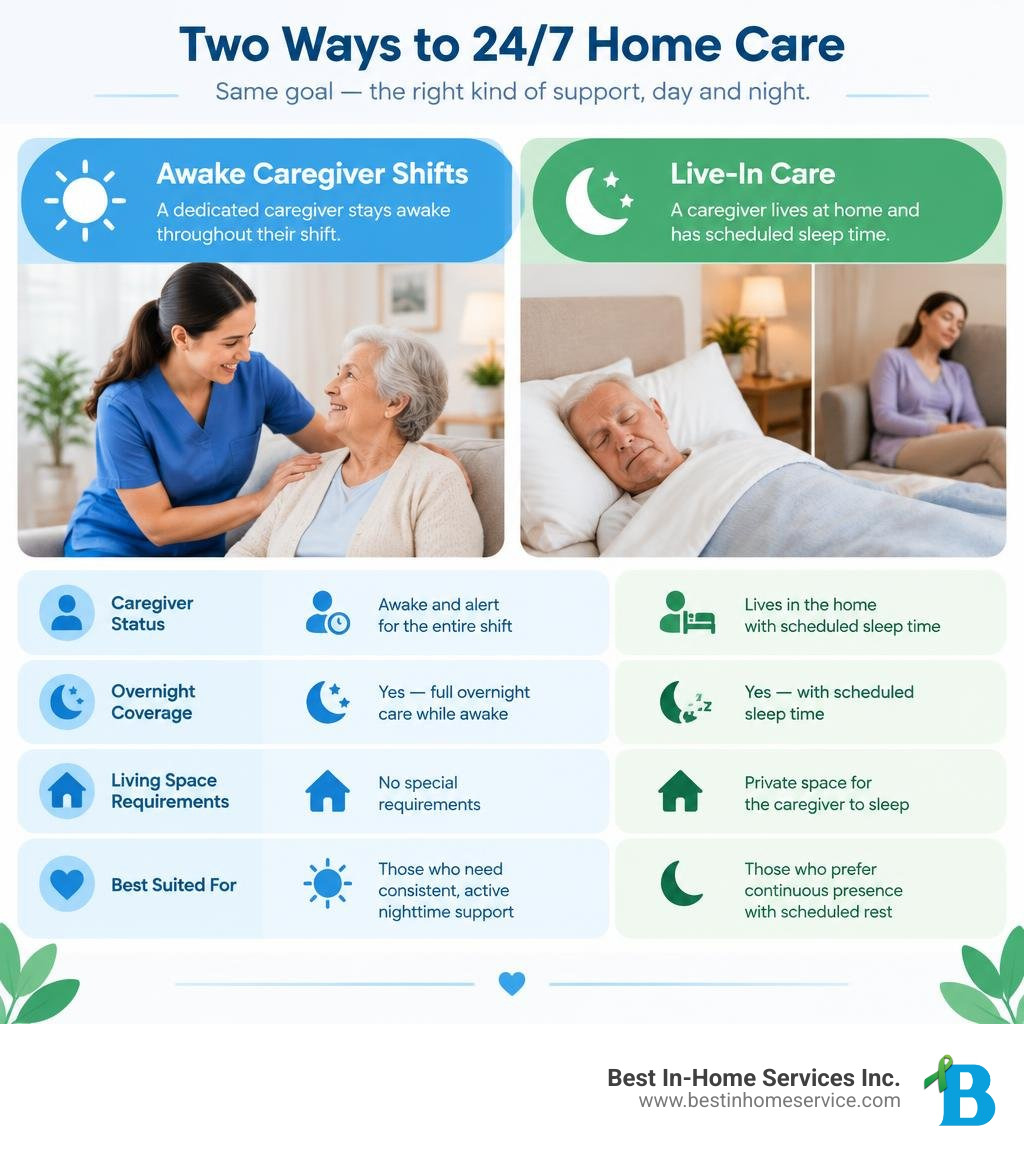
When families realize an aging parent requires around-the-clock attention, navigating the terminology can feel overwhelming. Continuous home support is generally arranged through two primary models: 24-hour shift care (often divided into two 12-hour or three 8-hour shifts) and live-in care. Choosing the right approach depends on nighttime needs, daily routines, and home layout.
| Care Model | Caregiver Status | Overnight Coverage | Living Space Requirements | Best Suited For |
|---|---|---|---|---|
| 24-Hour Shift Care | Rotating team of caregivers working scheduled shifts | Continuous awake monitoring and active supervision throughout the night | None; caregivers do not sleep on site | High-level nighttime needs, frequent waking, fall risks, advanced memory support |
| Live-In Care | Typically one or two dedicated caregivers staying in the home | On-call assistance with mandatory uninterrupted sleep time | Private bedroom and dedicated space for personal belongings | Predictable nighttime routines, companion needs, general daytime assistance |
In a 24-hour shift care arrangement, multiple professional caregivers rotate across day and night shifts. The overnight caregiver remains awake, alert, and active, providing continuous monitoring for safety concerns, nighttime wandering, or frequent bathroom visits. There is no need for a dedicated guest room, as staff members depart when their shift ends.
Conversely, live-in arrangements feature a consistent caregiver residing in the home for consecutive days. Under labor guidelines, live-in aides must receive an adequate, uninterrupted period of sleep alongside designated meal and personal breaks. If your loved one wakes multiple times during the night requiring hands-on help, a shift-care structure is generally safer and more practical. Exploring various live-in care options in Chicago helps families decide which schedule fits their household dynamic.
Assessing Your Needs for Anytime Home Care
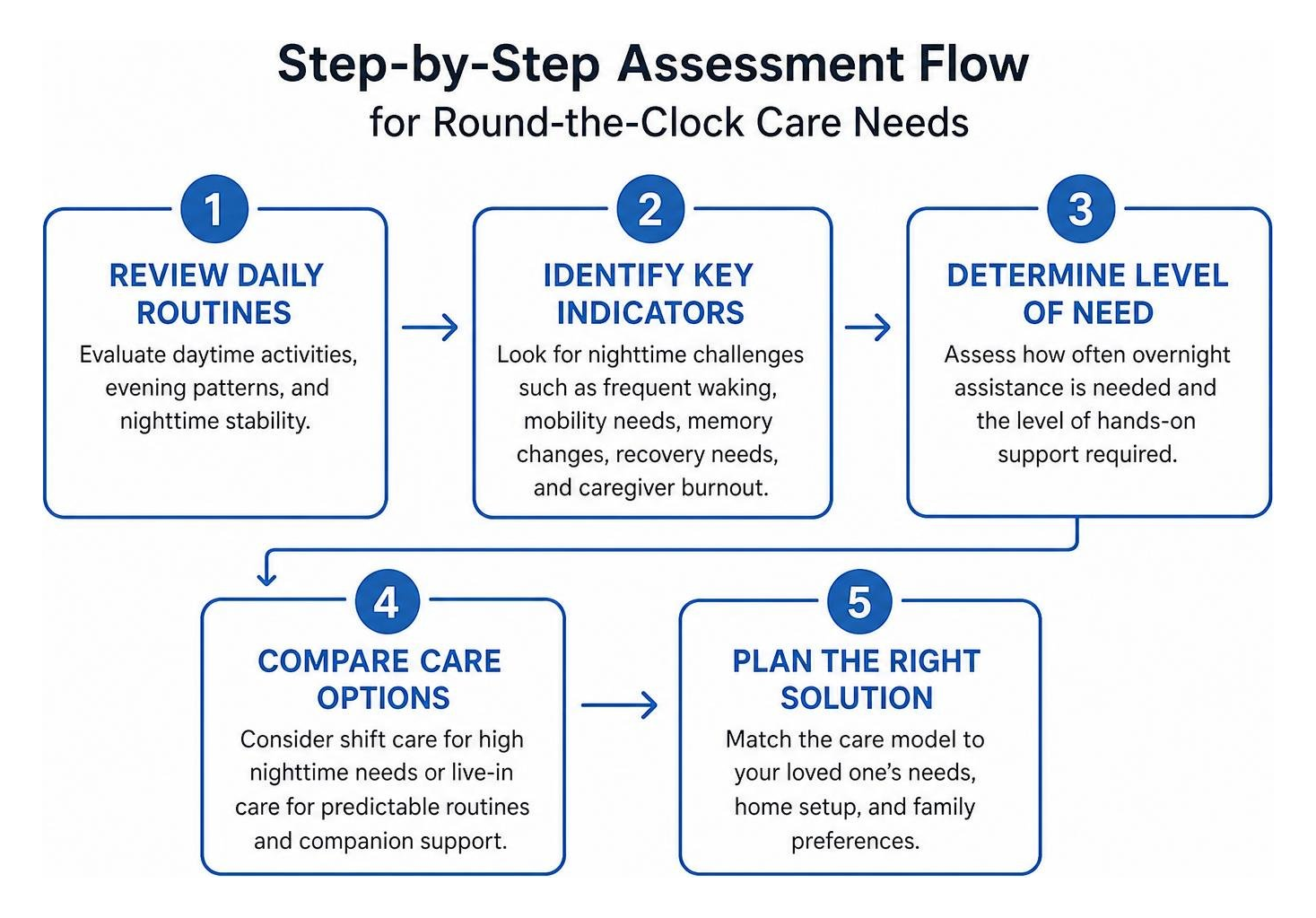
Determining whether continuous support is necessary involves evaluating daily activities and nighttime stability. Many families start with daytime companion visits or light housekeeping before realizing that overnight hours present the greatest challenges.
Key indicators that suggest round-the-clock home support may be beneficial include:
- Frequent Nighttime Awakening or Disorientation: Waking up confused, attempting to leave the home, or experiencing reversed sleep-wake cycles.
- Mobility Impairments and Transfer Challenges: Needing physical assistance to get in and out of bed, use the commode, or walk safely across dim hallways.
- Progressive Memory Changes: Wandering behaviors, stove safety concerns, or agitation during evening hours (often referred to as sundowning). Reviewing a comprehensive 24/7 dementia home care guide can provide deeper context on these behavioral patterns.
- Post-Rehabilitation Recovery: Returning home from a hospital or skilled nursing facility with temporary limitations requiring steady oversight.
- Family Caregiver Burnout: Family members suffering physical and emotional exhaustion from interrupted sleep and constant vigilance.
What Does Anytime Home Care Cost in Illinois?
The overall investment for continuous in-home support varies based on several core factors rather than a single flat fee. Because every senior’s routine is distinct, pricing reflects specific scheduling parameters, the level of non-medical hands-on assistance required, and local labor requirements.
Key variables affecting continuous home care costs include:
- Shift Structure vs. Live-In Rates: Hourly shift care accounts for continuous awake monitoring and involves multiple team members across 24 hours. Live-in care is structured on a specialized daily basis, provided the home can accommodate caregiver rest requirements.
- Schedule Customization: Whether care is required seven days a week or split across specific weekdays and weekends.
- Complexity of Non-Medical Support: Extensive physical assistance with bathing, personal hygiene, and transfers compared to companion-level oversight.
- Transportation and Travel Needs: When caregivers drive clients to appointments or run community errands, mileage is billed separately from standard service hours.
- Visit Minimums: Agencies, including Best In-Home Services Inc., maintain standard visit minimums (such as a 3-hour minimum per visit for part-time schedules) to ensure consistent, high-quality caregiver placement.
Families often fund round-the-clock support through private funds, long-term care insurance policies, or state-administered support programs. In Illinois, qualifying older adults may utilize benefits under the Community Care Program or the Department of Human Services Home Services Program. For an overview of financial planning approaches, consult our guide on finding affordable live-in care.
Key Services Provided During Round-the-Clock Care
Non-medical 24-hour home care covers a comprehensive spectrum of daily activities that keep older adults safe, comfortable, and socially engaged within familiar surroundings. Caregivers do not provide skilled clinical services like wound care or injections, but they handle the foundational tasks of daily living.

Core non-medical care services include:
- Personal Care Assistance: Respectful support with morning and evening routines, including bathing, dressing, grooming, oral care, and toileting.
- Mobility and Transfer Support: Steady guidance with walking, repositioning in bed, and transferring from chairs or wheelchairs to help reduce accidental strain.
- Nutritious Meal Preparation: Planning, cooking, and serving balanced meals tailored to dietary preferences, alongside routine cleanup.
- Medication Reminders: Prompting individuals to take prescribed medications on schedule as directed by their physicians.
- Light Housekeeping and Laundry: Washing bed linens, managing laundry, dusting, wiping down kitchen counters, and keeping walkways clear of clutter.
- Companionship and Mental Engagement: Meaningful conversation, accompanying seniors on walks, playing card games, and providing continuous social connection.
- Essential Errands and Accompaniment: Driving and escorting clients to medical appointments, pharmacy pickups, grocery shopping, and community social events.
- Family Respite: Offering family members a structured break to rest and manage personal responsibilities. Learn more about local relief models in our Chicago respite care options guide.
Coordinating Care and Ensuring Service Quality
Reliable round-the-clock care requires strong operational coordination. Quality agencies establish detailed, individualized care plans developed in close partnership with the client, their family, and relevant healthcare professionals. Regular communication ensures that as an individual’s mobility or memory needs evolve, the daily routine adapts seamlessly.
Regulatory compliance plays a major role in protecting consumers. In Illinois, reputable agencies are licensed and inspected by the Illinois Department of Public Health (IDPH). These regulatory frameworks establish strict standards for comprehensive background checks, ongoing caregiver training, supervisory visits, and administrative accountability. By adhering to Illinois Department of Public Health guidelines, licensed non-medical providers maintain structured oversight, verify caregiver credentials, and handle emergency protocols responsibly.
How to Set Up 24/7 Home Care for Aging Parents
Transitioning to round-the-clock home support is most successful when approached through a structured, step-by-step process:
- Initial Consultation: Connect with a care coordinator to discuss your loved one’s daily challenges, current mobility, and primary scheduling needs.
- Comprehensive In-Home Assessment: A representative visits the residence to evaluate home safety, identify environmental obstacles, and review daily routines in detail.
- Personalized Care Plan Development: Outline specific daily tasks, wake and sleep schedules, dietary guidelines, and communication preferences for family updates.
- Caregiver Matching: Match caregivers based on required skills, personality compatibility, and scheduling consistency.
- Service Orientation and Ongoing Oversight: Begin care with structured supervisory check-ins, adjusting routines as needed to maintain comfort and safety.
For families taking their first steps in organizing care across the northern suburbs, our beginner’s guide to home care in Northbrook walks through introductory planning checklists.
Frequently Asked Questions About 24/7 Home Care
What is the main difference between 24-hour shift care and live-in care?
The primary distinction lies in overnight coverage and living requirements. In a 24-hour shift model, two or three rotating caregivers work dedicated shifts, ensuring a caregiver is awake and active throughout the night. Live-in care involves a caregiver staying in the home who requires a private bedroom and an uninterrupted block of sleep each night.
How do state regulatory standards and health profiles protect care recipients?
State licensing bodies, such as the Illinois Department of Public Health, enforce strict operational guidelines for licensed home care agencies. These regulations require comprehensive criminal background checks, standardized staff training, regular supervisor visits, and formal complaint-tracking processes to protect care recipients.
Does insurance or state assistance cover 24/7 non-medical home care?
Traditional Medicare and standard health insurance typically do not cover long-term, non-medical daily living assistance. However, long-term care insurance policies often reimburse qualifying in-home personal care. Additionally, eligible Illinois seniors may access state-supported programs, such as the Community Care Program (CCP) or the Home Services Program (HSP), to help offset care costs.
Finding Trusted 24/7 Care in Chicago and the North Shore
Best In-Home Services Inc. is an Illinois-licensed home care agency (License #3000758) based in Northbrook, Illinois. We are licensed by the Illinois Department of Public Health, approved by the Illinois Department on Aging under the Community Care Program, and recognized by the Illinois Department of Human Services / Rehabilitation Services for the Home Services Program.
We provide dependable, non-medical home care support across Cook, Lake, and DuPage counties, including Chicago, Evanston, Skokie, Wilmette, Winnetka, Glencoe, Glenview, Highland Park, Lake Forest, Buffalo Grove, Schaumburg, Naperville, Downers Grove, and surrounding communities.
To learn more about our local services or to schedule a free in-home care assessment, explore our Northbrook home care services page or call us directly at 224-636-5200. Our office is located at 425 Huehl Rd, Bldg 13B, Northbrook, IL 60062.





 1-224-636-5200

 1-224-636-5210
 425 Huehl Rd 13B Northbrook IL 60062