
Understanding Your Options: Home Health Care Agency Chicago in 2026
Finding the right home health care agency in Chicago is one of the most important decisions a family can make for an aging loved one. Whether your parent needs skilled nursing after a hospital stay, help managing a chronic condition like diabetes or heart failure, or simply support with daily tasks — the options can feel overwhelming fast.
Here is a quick overview to help you find the right fit:
| What You Need | Type of Care | Common Payer |
|---|---|---|
| Skilled nursing, wound care, therapy after hospitalization | Skilled Home Health Care | Medicare, private insurance |
| Help with bathing, dressing, meals, companionship | Non-Medical Personal Care | Medicaid, private pay, CCP |
| Long-term support for seniors 60+ at home | Community Care Program (CCP) | Illinois Department on Aging |
| Care for eligible veterans at home | VA Community Care Network | Department of Veterans Affairs |
| Pediatric or adult private duty nursing | Private Duty Nursing | Private pay, Medicaid waiver |
The short answer: In Chicago, home health care agencies provide two broad types of services:
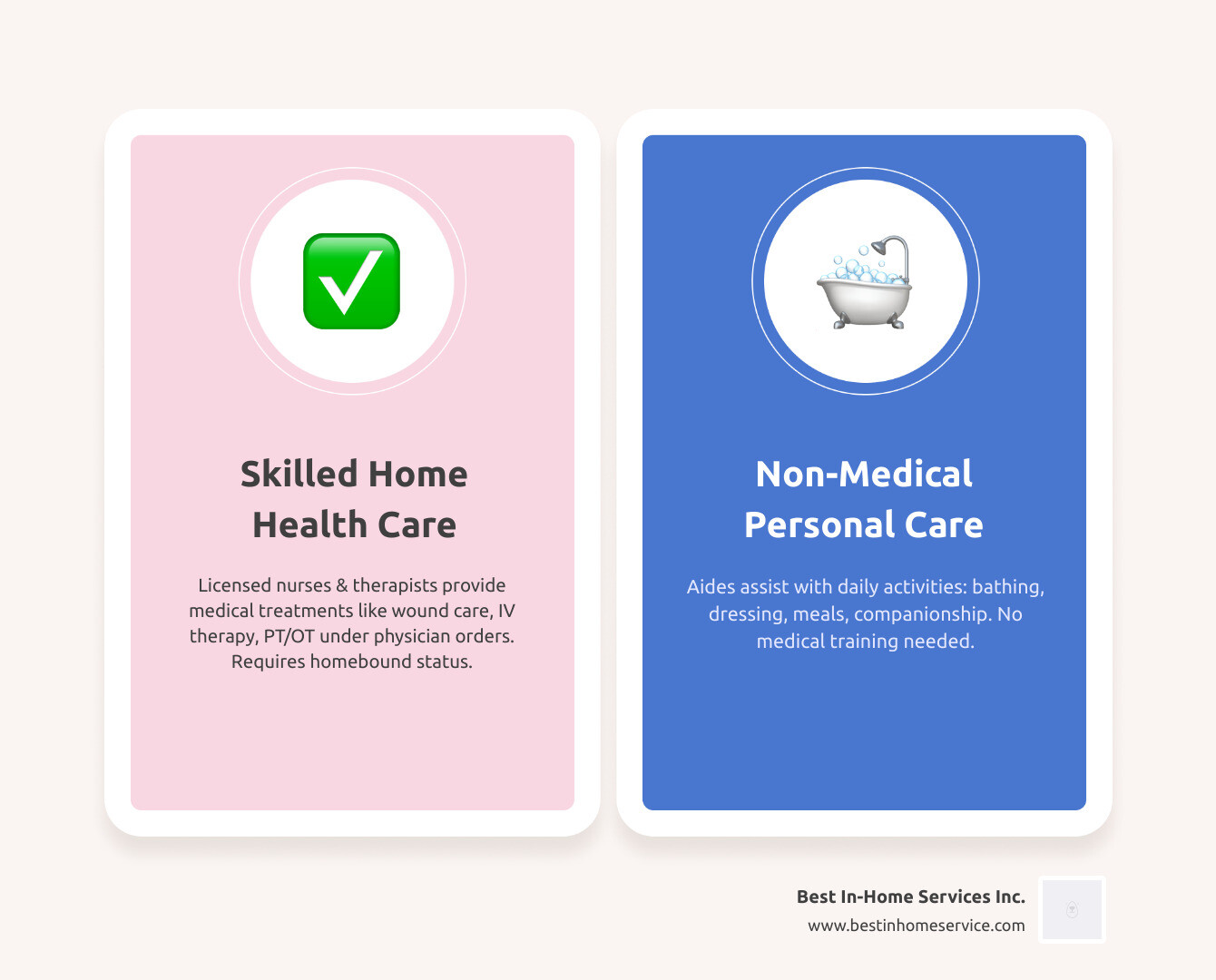
- Skilled medical care — licensed nurses and therapists treating you at home under a physician’s order
- Non-medical personal care — trained aides helping with daily activities like bathing, dressing, and meal prep
Illinois law requires that all home health agencies be licensed by the Illinois Department of Public Health (IDPH). Medicare-certified agencies must also meet federal quality and safety standards.
Many families don’t realize that Medicare often covers skilled home health visits at no out-of-pocket cost for eligible patients — and that care can typically begin within 24 to 48 hours of a referral.
This guide walks you through everything: how to choose a trustworthy agency, how to navigate insurance and state programs, and how to get care started quickly and confidently.
Introduction: Understanding Eligibility and Care Types in 2026
As we navigate the healthcare landscape of 2026, the demand for high-quality home health care agency Chicago services has never been higher. For many of our neighbors in Cook, Lake, and DuPage counties, the goal is simple: staying safe and independent at home. But before you can dive into the specifics, you need to know if your loved one qualifies and what “type” of care is actually needed.
Skilled Nursing and Medical Care
This is clinical care provided by Registered Nurses (RNs), Licensed Practical Nurses (LPNs), and therapists. To qualify for this under Medicare, a patient must be “homebound,” meaning their condition makes it difficult to leave the house without significant effort or the help of another person. Common needs include wound care, IV therapy, and post-surgical rehabilitation.
Non-Medical Care and Personal Support
If your loved one doesn’t necessarily need a nurse to change a bandage but does need help with “Activities of Daily Living” (ADLs)—like bathing, grooming, and meal preparation—they need non-medical personal care. This type of care focuses on safety and quality of life.
Eligibility and Payer Sources
- Medicare: Typically covers 100% of skilled home health services for homebound patients under a doctor’s care.
- Medicaid Waivers: Programs like the Home Services Program (HSP) help people with disabilities stay at home instead of entering a nursing facility.
- VA Community Care: Veterans in Chicago can often access private home health services through the VA Community Care Network (VACCN) if VA facilities aren’t easily accessible.
- Private Insurance: Often covers a portion of both skilled and non-medical care, though benefits vary wildly.

Selecting the Best Home Health Care Agency Chicago for Your Family
With hundreds of providers serving the Chicagoland area, how do you separate the “okay” from the “exceptional”? It starts with verification. In Illinois, every agency must be licensed by the Illinois Department of Public Health (IDPH). This ensures they follow state-mandated safety protocols and conduct proper background checks on their staff.
When researching, we recommend looking at Medicare Star Ratings. These ratings reflect patient satisfaction and clinical outcomes, such as how often the agency prevents hospital readmissions. A high-quality home health care agency in Chicago should also be transparent about patient rights. You have the right to participate in your care planning and the right to choose your provider.
If you ever feel that care isn’t meeting standards, the Home Care Ombudsman is a vital resource for filing complaints and ensuring your voice is heard. For a comprehensive list of vetted options, you can explore this resource on Home Health Care Agencies in Chicago and Illinois.
At Best In-Home Services Inc., we believe the best way to judge an agency is through the experiences of others. We encourage you to read our Testimonials to see how we’ve supported families across the city and suburbs. Understanding Why Choose Bihs comes down to our commitment to 24/7 support and our specialized focus on dementia and memory care.
Navigating the Transition: From Referral to First Visit
The move from a hospital bed to a home bed is a critical window. Research shows that the first 48 hours are the most important for preventing a return trip to the ER. The process usually begins with a physician’s order. If your loved one is currently in a facility, the discharge planner or case manager will send a referral to the home health care agency Chicago of your choice.
Once the referral is accepted, the “Start of Care” (SOC) assessment should happen quickly—ideally within 24 to 48 hours. This isn’t just a quick check-in; it’s a deep dive into the patient’s health status, home safety, and medication list.

For a deeper dive into this transition, check out our guide on Navigating Home Health Care.
The Process of Starting with a Home Health Care Agency Chicago
When we arrive for that first visit, our goal is to eliminate the “headache” of healthcare logistics. Here is what you can expect:
- Initial Assessment: We evaluate physical health, mobility, and cognitive status.
- Medication Review: We cross-reference hospital discharge papers with what’s in the medicine cabinet to prevent dangerous drug interactions.
- Care Plan Coordination: We work directly with your primary doctor to finalize a plan that includes nursing, therapy, or aide visits.
- Environmental Safety Check: We look for fall risks like loose rugs or poor lighting.
Ready to take the first step? We offer a Free Assessment to help you understand exactly what level of care is right for your situation.
Clinical Support and Chronic Disease Management
Home health isn’t just about “checking in.” It’s about intensive clinical support that used to require a hospital stay. A modern home health care agency in Chicago provides a multidisciplinary team of experts.
- Skilled Nursing: Managing complex wounds, administering IV therapy, and monitoring vitals.
- Physical Therapy (PT): Helping patients regain strength and balance, especially after hip or knee replacements.
- Occupational Therapy (OT): Teaching patients how to perform daily tasks safely using adaptive equipment.
- Speech Pathology (ST): Crucial for stroke survivors or those with Parkinson’s who struggle with swallowing or communication.
Our Services are designed to meet these high-acuity needs, and we offer Individual Services tailored to the specific medical requirements of each patient.
Clinical Programs Offered by a Home Health Care Agency Chicago
Top-tier agencies use evidence-based programs to manage specific conditions. This “specialty care” is what keeps patients out of the hospital.
- Stroke Recovery: Focusing on neuro-rehabilitation and preventing secondary strokes.
- Diabetes Education: Using the “teach-back” method to ensure patients and families know how to manage insulin and monitor blood sugar.
- Heart Failure Management: Daily weight monitoring and symptom recognition to catch “flare-ups” early.
- COPD Support: Energy conservation techniques and proper use of oxygen or nebulizers.
| Feature | Skilled Medical Services | Non-Medical Personal Care |
|---|---|---|
| Goal | Recovery and Rehabilitation | Safety and Maintenance |
| Provider | RN, PT, OT, SLP | Certified Nursing Assistant (CNA), Aide |
| Orders | Requires Physician Signature | No Doctor Order Needed |
| Duration | Short-term (weeks/months) | Long-term (months/years) |
Illinois State Programs and Financial Resources
For many Chicagoans, the cost of long-term care is a major concern. Fortunately, Illinois has some of the most robust state-funded programs in the country to support aging in place.
- Community Care Program (CCP): Managed by the Illinois Department on Aging (IDOA), this program provides free or low-cost in-home services to seniors 60+ who meet certain asset limits. It’s designed specifically to prevent unnecessary nursing home placement.
- Senior HelpLine (1-800-252-8966): This is your go-to starting point for navigating state resources.
- Home Services Program (HSP): Operated by the Division of Rehabilitation Services (DRS), this helps individuals with disabilities under age 60 remain in their homes.
Whether you are looking for home health care in Chicago Downtown or support in the heart of the city, understanding these programs can save your family thousands of dollars. We specialize in helping families navigate Home Services and Personal Care options that fit within these state frameworks.
Frequently Asked Questions about Chicago Home Care
How much does home health care cost in Chicago?
If you qualify for “Skilled Home Health” under Medicare, the cost is typically $0 for the visits. For non-medical care, prices in Chicago are usually billed hourly. Many families use long-term care insurance, VA benefits, or the Community Care Program to cover these costs. We always recommend an insurance verification before care begins so there are no surprises.
How quickly can care begin after a hospital stay?
In the Chicago area, the standard is a 24-to-48-hour window. Once your doctor or the hospital discharge planner sends the referral, a home health care agency Chicago can often have a clinician at your door the next day. The speed depends on how quickly the physician signs the authorization.
Can family members be paid caregivers in Illinois?
Yes! Under the Illinois Community Care Program (CCP), family members—including spouses—can be hired as paid caregivers. However, they must meet specific IDOA regulations, complete 24 hours of pre-service training, and pass a comprehensive background check through the Healthcare Worker Registry.
Conclusion
Navigating home health doesn’t have to be a headache. Whether you are in the Gold Coast, Naperville, or Northbrook, the key is finding a partner that treats your family like their own. At Best In-Home Services Inc., we provide more than just “visits.” We provide 24/7 support with a certified staff that specializes in the complex needs of dementia and memory care.
Our custom care plans are designed to evolve as your loved one’s needs change, ensuring they always have the right level of support. From skilled nursing to compassionate companionship, we are here to ensure that “home” remains the safest and most comfortable place to be.
To learn more about our mission and our team, visit our About Us page, or contact our Chicago office today to schedule your free consultation. Let us help you find the peace of mind your family deserves.






 1-224-636-5200
 1-224-636-5210
  425 Huehl Rd 13B Northbrook IL 60062