
What Home Care Agencies Actually Do (And How to Find the Right One)
Home care agencies help seniors and people with disabilities get professional support right in their own homes — without moving to a facility.
Here’s a quick overview of what they offer:
| Type of Service | What It Includes |
|---|---|
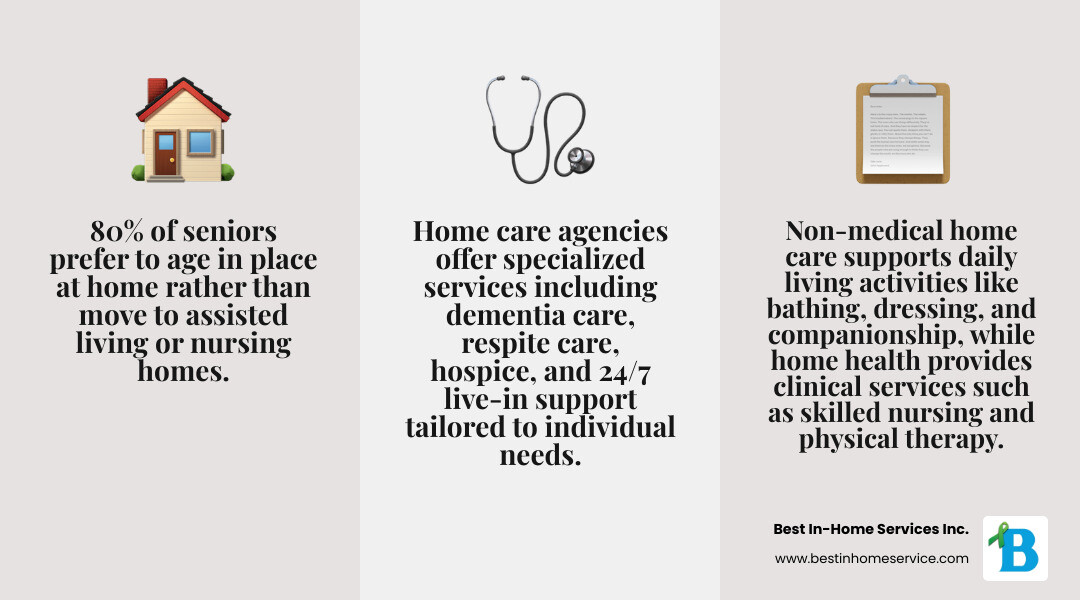
| Non-medical home care | Bathing, dressing, meal prep, companionship, transportation |
| Home health care | Skilled nursing, physical therapy, medication management |
| Dementia & memory care | Specialized support for Alzheimer’s, dementia, cognitive decline |
| Respite care | Temporary relief for family caregivers |
| Hospice & palliative care | Comfort-focused support for end-of-life needs |
| 24/7 live-in care | Around-the-clock assistance for high-need individuals |
Most families turn to a home care agency when a loved one needs more help than family alone can provide — but isn’t ready for a nursing home or assisted living facility.
And that’s a very common situation. According to AARP, 80% of people prefer to stay at home as they age. The challenge is finding an agency you can actually trust — one with certified caregivers, personalized care plans, and real availability when you need them most.
That’s exactly what this guide covers.
I’m Lily Harrison, General Manager at Best In-Home Services Inc., where I’ve spent years coordinating compassionate, certified care for Chicago-area families navigating home care agencies — especially those facing dementia, memory care, or the need for 24/7 support. I’ll walk you through everything you need to know to make a confident, informed decision for your loved one.
Understanding the Different Types of Home Care Services
When you start searching for home care agencies, the terminology can get a bit confusing. It is important to distinguish between “home care” and “home health,” as they serve different purposes and are regulated differently here in Illinois.
Non-medical home care focuses on the activities of daily living (ADLs). This is what we primarily think of when we talk about helping a senior “age in place.” It includes things like companionship, light housekeeping, and personal care. On the other hand, “home health” is clinical. It involves registered nurses (RNs), physical therapists, and occupational therapists who provide medical treatment under a doctor’s orders.
Hospice care is another specialized branch, focusing on comfort and dignity for those with terminal conditions, typically within the last six months of life. For family members who are currently the primary caregivers, respite care provides a much-needed temporary break to prevent burnout.
Medical Home Health vs. Non-Medical Home Care
| Feature | Home Health Care | Non-Medical Home Care |
|---|---|---|
| Primary Goal | Medical recovery or management | Assistance with daily living |
| Staff | Nurses, PTs, OTs, Speech Therapists | Certified Caregivers, Home Care Aides |
| Medication | Can administer injections/wound care | Medication reminders and assistance |
| Payment | Often Medicare/Insurance (Short-term) | Private pay, LTC insurance, VA (Long-term) |
| Duration | Episodic (based on medical need) | Ongoing (based on lifestyle need) |
To see how these services can be blended into a comprehensive plan for your family, you can explore our full range of Services.
Specialized Support from Home Care Agencies
Reputable home care agencies do much more than just “watch” a client. Companion care addresses the epidemic of senior isolation by providing meaningful social interaction. Personal care ensures that hygiene, such as bathing and grooming, is handled with dignity.
One of the most critical non-medical tasks is medication reminders. While a non-medical caregiver cannot “prescribe” or “administer” via injection, they are vital in ensuring that pills are taken on time and as directed by the physician.

Post-Acute Transitions and Hospital Coordination
The period immediately following a hospital discharge is high-risk. Without proper coordination, seniors are often readmitted within 30 days. We work closely with hospitals and physicians to ensure a smooth transition of care. This involves reviewing discharge papers, setting up the home environment for safety, and coordinating with post-acute facilities.
If you are currently dealing with a discharge from a facility in Cook or DuPage County, Navigating Chicago Home Health Care Without the Headache offers a roadmap for these stressful moments.
How to Evaluate and Choose the Best Home Care Agencies
Choosing between home care agencies is one of the most significant decisions a family will make. It’s not just about finding a “worker”; it’s about finding a partner who fits your family’s culture and specific health needs.
A major part of our process at Best In-Home Services Inc. is caregiver matching. We don’t just send whoever is next on the list; we screen for empathy and match based on personality, language preferences, and specialized skills.
For those in the Chicago area, you can find a curated list of resources through the Shirley Ryan AbilityLab’s Home Health Care Agencies in Chicago and Illinois. Additionally, we’ve put together a guide on the Home Care Agency in Chicago: The No-Stress Shortlist to help narrow your search.
Essential Factors for Selecting a Provider
When vetting an agency, look beyond the marketing.
- Accreditation: Is the agency licensed by the Illinois Department of Public Health?
- Reviews: Check platforms like Google for recent feedback.
- Complaint History: Don’t be afraid to ask an agency how they handle client grievances.
- Longevity: Agencies that have been around for years often have more robust training programs.
You can read what other families have experienced by visiting our Testimonials page.
The Importance of In-Home Assessments
Never sign a contract with an agency that hasn’t performed a thorough in-home assessment. This is a critical step where we identify safety hazards, such as loose rugs or poor lighting, that could lead to falls. During this visit, we develop an itemized care plan that details exactly what the caregiver will do each day.
Ready to see what a plan would look like for you? We offer a Free Assessment to get you started.
Specialized Care Programs and Aging in Place
As we move through 2026, the technology and training for “aging in place” have reached new heights. Specialized programs for dementia, Alzheimer’s, and Parkinson’s are now the gold standard. These aren’t just generic care plans; they are “person-centered” approaches that focus on what the client can still do, rather than just their limitations.
With the 80% preference for staying home mentioned earlier, these specialized programs are what make that preference a safe reality. For example, memory care at home involves cognitive stimulation, specialized meal planning to ensure nutrition, and “Meaningful Activities” that tap into the senior’s social history and hobbies.

Benefits of Aging in Place with Home Care Agencies
The benefits of staying home are both emotional and physical. Seniors in familiar environments often experience better mental well-being and less “sundowning” (confusion that occurs in the evening for those with dementia). Furthermore, being at home allows for better social engagement with neighbors and family, which is often lost in a facility setting.
Physically, recovery from illness or surgery is often faster at home because the risk of hospital-acquired infections is lower. You can learn more about how we facilitate this through Our Specialized Home Care Services. For 24/7 needs, check out Finding the Best 24/7 Home Health and Memory Care in Chicago.
End-of-Life and Palliative Support
When a loved one reaches the end of their journey, the goal shifts to “comfort care.” Home care agencies work alongside hospice providers to provide 24/7 presence, ensuring the client is never alone and the family has the emotional support and respite they need. To learn more about our mission in these moments, visit our About Us page.
Licensing, Regulations, and Caregiver Standards
In Illinois, home care agencies must be licensed and follow strict regulatory frameworks. This includes the Home Care Services Consumer Protection Act, which ensures that agencies are held to high standards regarding background checks and worker safety.
Reputable agencies are often members of the Home Care Association of America (HCAOA). Research shows that HCAOA member agencies generate 45% more revenue than non-members, largely because they invest more in education, training, and advocacy.
Training and Screening Requirements
At Best In-Home Services Inc., our screening process is rigorous. It’s not just about a clean background check; we screen for empathy and “Interactive Caregiving” skills. Some of the most advanced agencies now use high-acuity simulation labs to train staff for real-world scenarios, such as emergency readiness or transferring a client safely from a bed to a wheelchair.
Our commitment to these standards is why many choose us; read more about Why Choose BIHS.
State-Specific Regulatory Frameworks
Illinois requires Home Care Organizations to be licensed through the Department of Public Health. You can verify an agency’s standing and check for any violations through the Illinois Department of Public Health – Health Care Regulation portal. Additionally, the In-Home Service – Illinois Department on Aging provides resources for seniors who may qualify for state-subsidized “Homemaker” services.
Payment Options and Financial Planning for Home Care
One of the most common questions we hear is, “How do we pay for this?” While non-medical home care is often “private pay,” there are several other avenues to explore.
- Long-Term Care Insurance: This is a primary source of funding for many of our clients.
- Medicaid: For those who qualify financially, programs like the Illinois Community Care Program (CCP) can help.
- VA Benefits: Veterans may be eligible for “Aid and Attendance” benefits which can significantly offset costs.
- Private Pay: Using savings or home equity.
For those in DuPage County, the Community Services Programs | DuPage Co, IL offers guidance on local assistance programs.
Utilizing Veteran Benefits for Home Care
We are proud to serve those who served. VA programs can sometimes fully fund home care for eligible veterans. This support allows veterans to stay in their homes while receiving the respect and dignity they deserve.
Navigating Medicare and Medicaid Coverage
It is a common misconception that Medicare pays for long-term, non-medical home care. Generally, Medicare only pays for “Home Health” (medical) on a short-term basis following a hospital stay. To see what is currently covered, visit the Medicare.gov – Home Health Services Coverage page.
Frequently Asked Questions about Home Care
How do I find home health providers near me?
The best place to start for medical home health is the Medicare Care Compare Tool. You can search by zip code to see quality ratings and patient outcomes for certified providers in your specific Chicago suburb.
What quality information is available for home care agencies?
Look for certification status and HCAOA membership. You can also ask for an agency’s “Social History” assessment process. If you have specific questions about our quality standards in the Northbrook or Skokie areas, please reach out via our Contacts page.
How are care plans customized to individual needs?
A good care plan is a living document. It should include the client’s social history, dietary needs, and 24/7 availability requirements. At Best In-Home Services Inc., we use proprietary diagnostic tools to provide real-time, itemized care plans that evolve as the client’s needs change.
Conclusion
Choosing between home care agencies doesn’t have to be an overwhelming process. By focusing on certified staff, specialized memory care expertise, and a commitment to 24/7 support, you can ensure your loved one remains safe and happy at home.
Best In-Home Services Inc. has been a cornerstone of the Chicago elder care community, serving locations from Winnetka to Naperville and everywhere in between. We are here to help you navigate this journey with compassion and professional excellence. When you’re ready to take the next step, explore our Services and let us help your family find the peace of mind you deserve.







 1-224-636-5200
 1-224-636-5210
  425 Huehl Rd 13B Northbrook IL 60062